

Uganda has built many of the rails needed to move money digitally. The next challenge is considerably harder: using those rails to bring affordable finance to farmers and productive businesses while mobilising the patient capital needed for the country’s long-term growth ambitions.
A farmer can receive money on a mobile phone. A trader can deposit cash through a banking agent. A customer can transfer funds without entering a branch.
Those changes have fundamentally altered what access to finance looks like in Uganda.

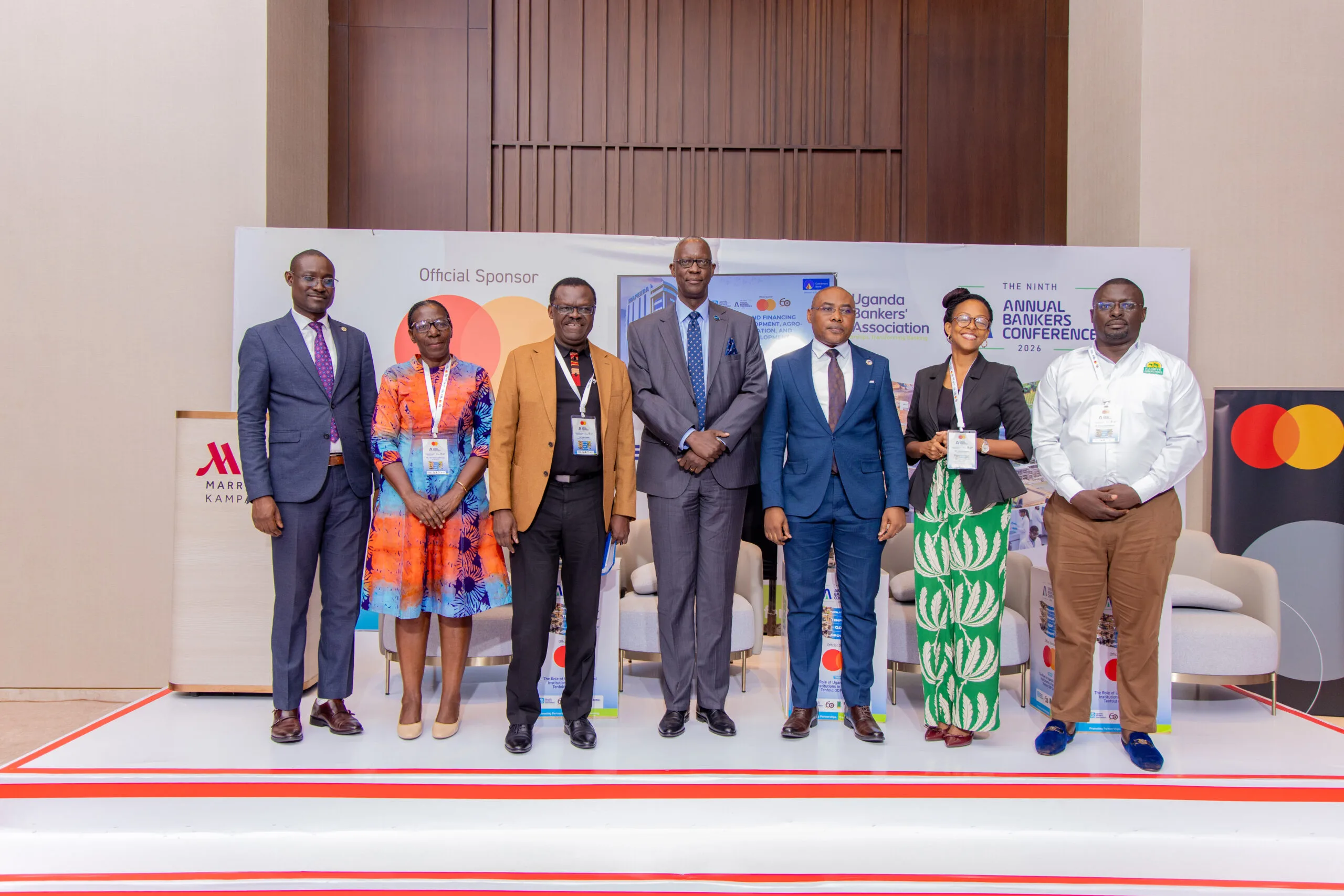
But at the ninth Annual Bankers Conference in Kampala, government, regulators, bankers and development partners increasingly focused on another question: what happens after access?
If Uganda wants to grow its economy from about US$50 billion to US$500 billion by 2040, simply increasing the number of people who can make a digital transaction will not be enough.
Financial inclusion will increasingly have to translate into investment, production, business expansion, employment and income.
The Minister of Finance captured that distinction in his remarks to the conference.
“Financial inclusion must therefore move from access to actual economic transformation.”
The government argues that Uganda already possesses significant pieces of the infrastructure needed for this next stage, including mobile money, agency banking and other digital financial rails. The challenge is extending those capabilities to people participating in productive sectors, particularly the millions of farmers the government wants to commercialise under the Parish Development Model.
For a farmer producing for the market, financial inclusion should eventually mean more than possessing an account or mobile wallet. It should mean being able to save, borrow, insure, receive payments and reinvest in production.
That sounds straightforward. Financing it is not.
Uganda’s credit gap is still enormous
One of the clearest messages from the conference was the sheer scale of financing required to underpin Uganda’s tenfold growth target.
The government says private-sector credit will have to rise from approximately UGX28 trillion to UGX490 trillion by 2040, while mobilisation through capital markets would need to increase from about UGX1.5 trillion to UGX440 trillion.
Those figures illustrate why the debate is moving beyond conventional bank lending.
According to the Finance Minister’s remarks, only 12% of Ugandans currently access formal credit, while average lending rates are between 18% and 20%, and more than 70% of lending is short-term.
The government argues that such a financing structure cannot adequately support the kind of transformation envisioned under the ATMS framework.
Factories, tourism facilities, mines, processing plants and technology parks may require financing lasting ten, 15 or even 20 years. Commercial lending, meanwhile, has traditionally been much shorter-term.
That is where patient capital enters the conversation.
Patient capital is, at its simplest, money willing to wait.
Rather than requiring rapid repayment or immediate returns, it can remain invested over longer periods, giving businesses and projects time to become productive.
For Uganda, that distinction could determine whether ambitious development plans become investable projects or remain proposals.
Agriculture exposes the financing problem
Few sectors illustrate the challenge better than agriculture.
Agriculture accounts for a significant share of Uganda’s economy and supports millions of livelihoods, yet the Finance Minister said the sector receives only about 12% of financial-sector lending despite accounting for 26.2% of GDP. Tourism receives less than 2% and minerals less than 3%, according to figures presented in his remarks.
There are understandable reasons lenders approach agriculture cautiously.
Weather, price volatility, fragmented supply chains and limited collateral can all increase lending risk. Many agricultural enterprises are small and geographically dispersed, increasing transaction costs for lenders.
But simply describing agriculture as risky does not solve the financing problem.
One of the more interesting examples presented at the conference came from the Netherlands’ work in Uganda.
The Dutch Ministry of Foreign Affairs, through Aceli, has been supporting efforts to encourage lending to agricultural SMEs using financial incentives to de-risk loans, capacity-building for lenders and businesses, and work on the wider regulatory environment.
According to remarks delivered by the Ambassador of the Kingdom of the Netherlands to Uganda, Aceli has worked with 20 financial institutions over the past five years to mobilise US$125 million in lending to about 2,000 agricultural SMEs, with the businesses providing market access and employment to an estimated 400,000 smallholder farmers and workers.
For every dollar deployed in incentives, the programme says it has unlocked approximately US$9 in private-sector lending.
That example is significant because it shifts the question from why banks do not lend to what can be changed to make lending viable.
Risk does not necessarily have to disappear. It can sometimes be shared.
Patient capital reaches the farmer
Another Dutch-backed initiative takes the model further down the financial chain.
Through Pearl Capital Partners, the Dutch government has invested €8 million in a Smallholder Credit Fund that provides medium-term credit lines to SACCOs, farmer cooperatives and microfinance institutions.
Over the previous three years, the initiative had invested UGX31 billion across 60 farmer institutions, benefiting more than 21,000 farmers, according to the Ambassador’s remarks.
This offers a useful illustration of what financial inclusion can look like beyond opening accounts.
A smallholder farmer may be too small to borrow directly from a large commercial bank. A farmer cooperative, SACCO or microfinance institution may understand that customer and local market better.
Patient capital provided further up the chain can therefore move through institutions already closer to the farmer.
Technology can potentially make that system more efficient — through digital payments, transaction histories, remote servicing and data — but technology alone does not absorb agricultural risk.
The financing structure matters just as much as the digital channel delivering it.
Green finance enters the equation
The Netherlands’ engagement with Uganda’s financial sector also introduces another dimension: environmental and climate risk.
Through FMO, the Dutch Entrepreneurial Development Bank, a partnership with the Uganda Bankers Association is supporting the Association’s 34 supervised financial institutions in areas including ESG integration, climate-risk management, sustainable finance and sustainability reporting.
The programme is intended to help institutions translate Uganda’s industry-wide ESG framework into practical policies, tools and business opportunities.
That work could become increasingly relevant to how Ugandan institutions raise money internationally.
Bank of Uganda Governor Michael Atingi-Ego noted that institutions seeking longer-term sustainable and green financing are increasingly encountering strong environmental, social and governance practices as a prerequisite for accessing global capital.
ESG therefore becomes more than a reporting exercise.
For banks trying to finance agriculture, tourism and infrastructure — sectors exposed to environmental and climate risks — the ability to understand those risks could affect both their lending decisions and their own ability to attract capital.
The digital rails still matter
None of this diminishes the role technology has played in broadening Uganda’s financial system.
Digital payments, mobile money and agent banking have dramatically changed the economics of reaching customers outside traditional banking networks.
The next stage is about making those rails do more.
Digital transaction histories can potentially contribute to credit assessment. Remote distribution can lower the cost of serving customers. Digital payments can improve visibility across agricultural value chains. Technology can make insurance, savings and credit products easier to distribute.
The central bank has signalled that it intends to continue enabling agent banking, digital distribution and responsible product innovation while simultaneously strengthening cyber resilience, credit information, collateral registries and sectoral data.
That final point is crucial.
A digital financial system creates opportunity, but it also creates new vulnerabilities. As more economic activity becomes dependent on digital infrastructure, cyber resilience becomes part of financial stability rather than merely an IT concern.
Banks cannot do it alone
Perhaps the strongest area of consensus across the speeches was that Uganda cannot fund its transformation entirely through commercial bank balance sheets.
Mugabi argued that the financial sector needs to mobilise both traditional and non-traditional capital, naming equity finance, pension funds, diaspora capital, blended financing, venture funds, impact funds and sustainability finance among the mechanisms that could complement bank credit.
The Finance Minister similarly called for greater use of infrastructure bonds, project bonds, green bonds and equity financing, alongside deeper cooperation with the Capital Markets Authority.
This matters because Uganda has substantial pools of money whose investment horizons may be better suited to long-term projects than conventional deposits.
Pension funds, insurers and development finance institutions can potentially provide capital over longer periods. Capital markets can connect projects with investors without requiring banks to carry the entire financing burden.
Banks, meanwhile, can increasingly become arrangers and intermediaries within that ecosystem.
From a digital transaction to a productive economy
The ninth Annual Bankers Conference ultimately exposed two different meanings of financial inclusion.
The first is access: giving someone the ability to make payments, open an account, use an agent or participate in a digital financial network.
Uganda has made considerable progress on that front.
The second is much more difficult: giving that person access to financial services that materially change what they can produce, build or earn.
For a farmer, that might mean financing irrigation, storage or equipment. For an agricultural SME, it could mean capital to build processing capacity. For a tourism operator, it might mean longer-term financing for accommodation or transport. For an entrepreneur, it could mean credit based on business cash flows rather than the land they own.
The Finance Minister has proposed an ATMS Financing Compact between government and the banking sector, with measurable commitments covering credit growth, pricing, productive-sector lending and financial inclusion.
Whether such commitments ultimately translate into significantly more affordable and productive finance will matter more than the declarations themselves.
Uganda already has much of the technology required to move money.


