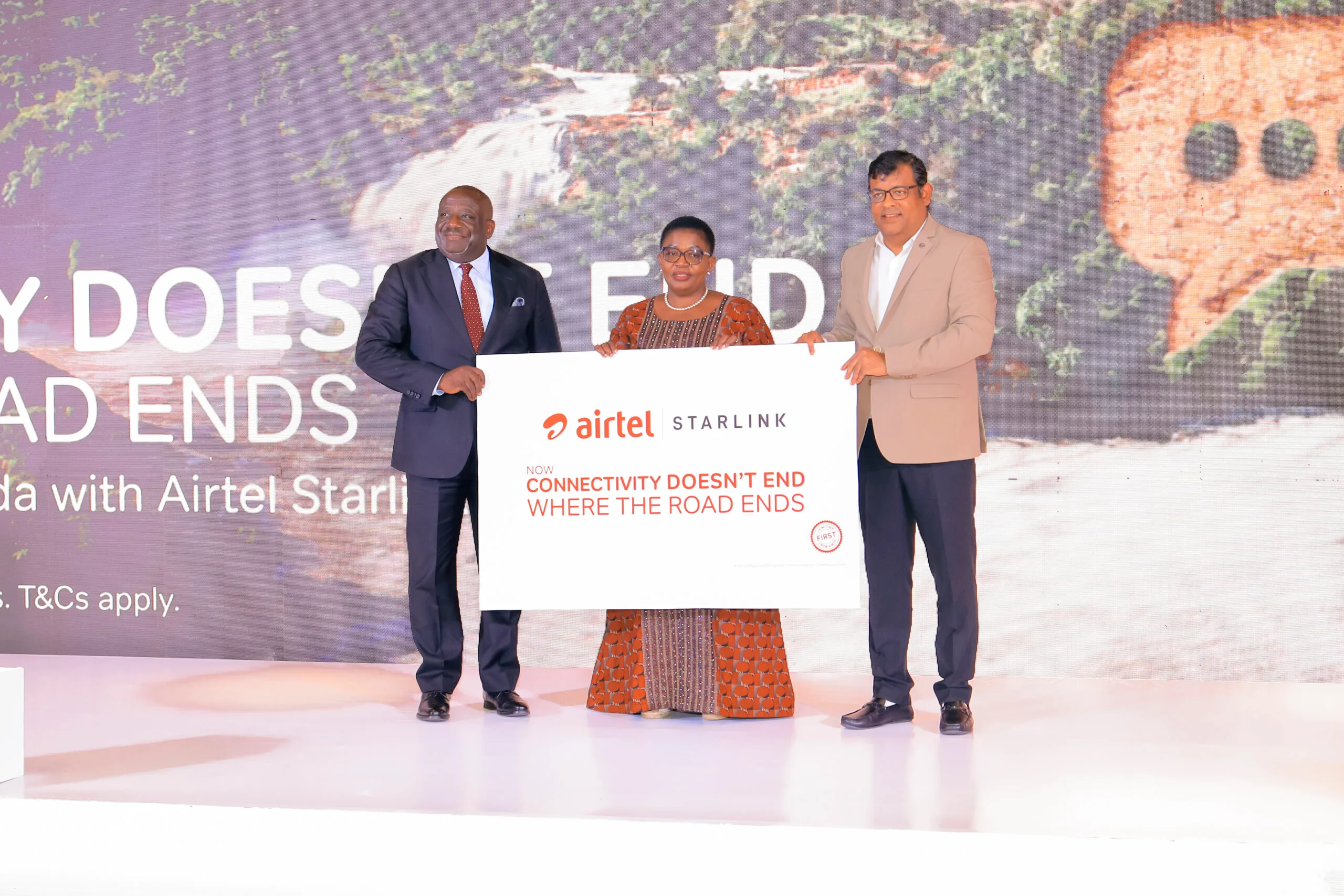


For years, losing mobile network coverage in Uganda has often meant one thing: waiting until you get back within range of a telecom tower.
Airtel Uganda is attempting to change that experience by taking connectivity beyond conventional terrestrial infrastructure and, quite literally, into space.
Launched on September 24, 2026, Airtel Starlink allows eligible Airtel customers to connect their mobile phones directly to Starlink satellites when they move outside the reach of Airtel’s terrestrial mobile network. And, as part of the launch promotion, customers can try the service free for the first 30 days.
But despite the Starlink name, this is not the satellite broadband service most consumers may already know.
There is no satellite dish to install, no Starlink router to purchase and no separate internet subscription required. Instead, Airtel Starlink is a direct-to-cell satellite service designed to make an ordinary compatible smartphone capable of connecting to satellites when conventional mobile coverage disappears.
So, how does Airtel Starlink actually work?
Under normal circumstances, nothing changes.
An Airtel customer’s phone continues connecting to the company’s terrestrial mobile towers wherever network coverage is available. Even where the phone has only a weak signal — perhaps just one bar — it remains on the terrestrial network.
The satellite service is intended to step in only when that connection disappears and the device displays messages such as “no service” or “emergency calls only.”
In such circumstances, a compatible phone can connect to Starlink’s constellation of roughly 650 direct-to-cell satellites, provided the user has a clear view of the sky.
That makes the technology particularly relevant for people travelling through remote rural areas, mountains, national parks or islands on Lake Victoria where building conventional telecom infrastructure can be difficult or uneconomical.
It could also provide an alternative communications layer during emergencies in which terrestrial networks are unavailable.
There is an important distinction, however: Airtel Starlink is a coverage gap-filler, not a signal booster. If a user already has an Airtel signal, however weak, the phone does not switch to satellite simply to provide a stronger connection.
No dish, new SIM or special satellite phone
Perhaps the most significant part of the proposition is what customers do not need.
There is no additional satellite hardware or dish, and customers do not have to replace their existing Airtel SIM.
At launch, however, support is limited to compatible Android smartphones, meaning not every Airtel subscriber will immediately be able to access the service. It is also designed for smartphones rather than MiFi devices and routers.
To activate the offer, eligible customers need to open the MyAirtel App, locate the Airtel Starlink icon and opt in. They must also enable data roaming in their phone settings.
Signing up is free.
Airtel is offering the service free for the first 30 days as part of a launch promotion running until October 23, 2026.
What can you do with it?
This is another area where expectations need to be managed.
Airtel Starlink is not yet designed to reproduce the full mobile broadband experience customers receive through a 4G or 5G tower.
The initial service is centred on messaging and light internet usage.
Customers can send and receive SMS messages, including one-time passwords used for services such as Airtel Money. Supported services also include WhatsApp text messaging, Google Maps and the MyAirtel application.
That could still make a significant difference to someone stranded somewhere without conventional mobile coverage. The ability to send a WhatsApp message, access a map or receive an important verification code can be more valuable in such circumstances than high-speed browsing.
There are, however, clear limitations.
Voice and video calls are not supported at launch. Officials have indicated that calling capabilities are expected later, although no specific rollout date has been announced.
The service also requires users to have a reasonably clear view of the sky, a practical consequence of the phone communicating directly with satellites overhead.
What happens after the free 30 days?
Once the promotional period ends, Airtel customers will need an active eligible data bundle worth at least UGX2,000 to continue accessing the satellite service.
The precise qualifying bundles and whether additional charges could apply beyond the bundle have not yet been fully detailed in the public information surrounding the launch.
Customers will therefore need to check the MyAirtel App and Airtel Uganda’s official communication channels for current terms, supported devices and pricing information.
Part of a bigger African satellite push
Uganda is not the first Airtel Africa market to receive the technology.
The Ugandan rollout follows the commercial introduction of the service in the Democratic Republic of Congo in August 2026, making Uganda Airtel Africa’s second commercial market for the satellite-to-mobile offering.
The deployments form part of the wider partnership between Airtel Africa and Starlink announced in December 2025.
The significance of the technology is ultimately not that satellites are about to replace Uganda’s thousands of terrestrial mobile sites. They are not.
Instead, direct-to-cell technology attempts to address one of the enduring limitations of conventional mobile networks: there will always be places where extending towers and fibre is difficult, expensive or impractical.
Airtel Starlink adds another layer to that infrastructure.
For now, that layer comes with modest capabilities — texts, WhatsApp messages, maps and selected light-data services rather than calls, streaming and full broadband.


