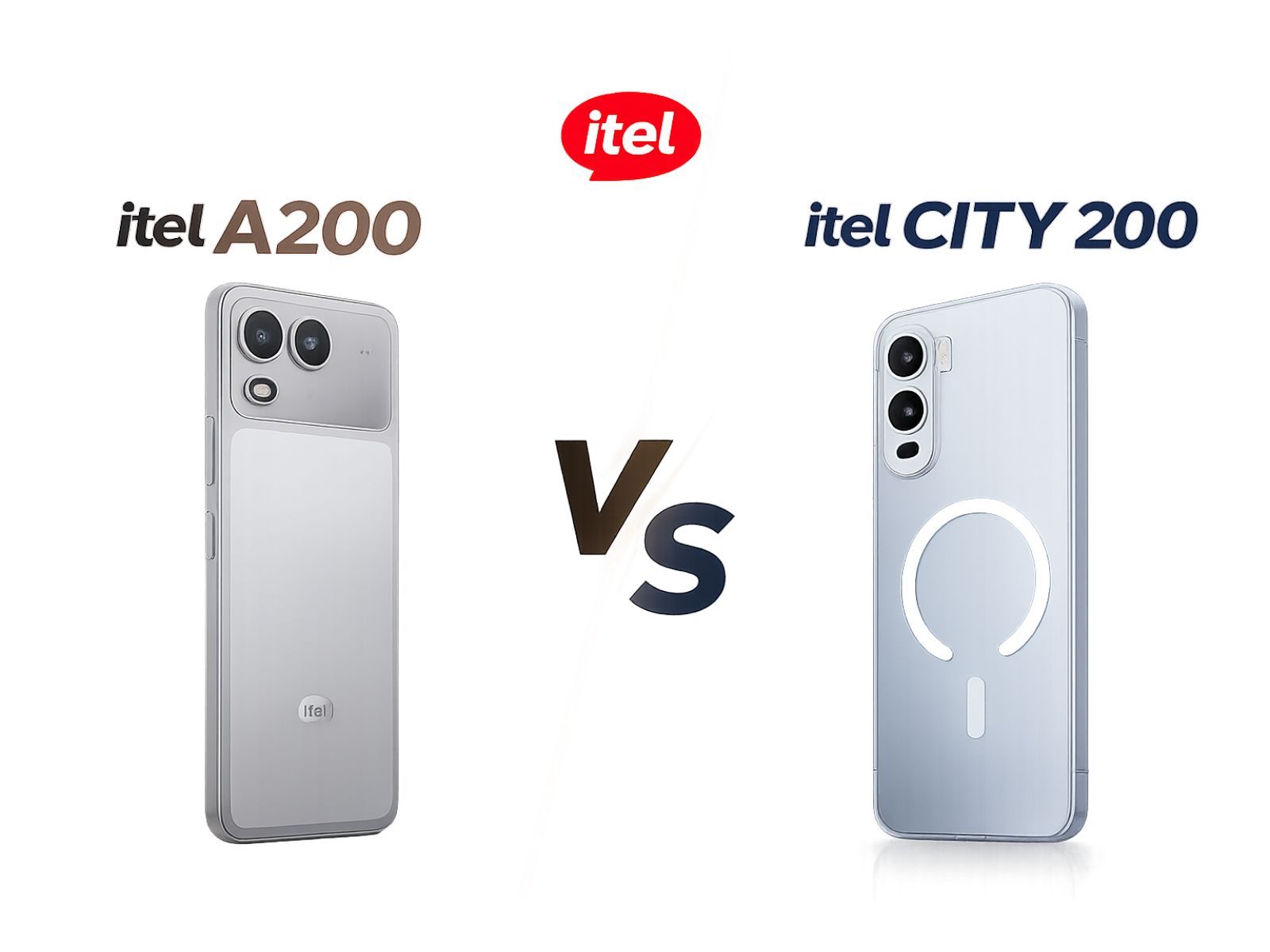


itel continues to deliver reliable devices that punch above their weight. Two of the brand’s latest releases, the itel City 200 and the itel A200, target everyday users who need a tough, modern phone without breaking the bank.
Both models share several core features, including the same Unisoc T7250 processor, 120Hz displays, IP65 dust and water resistance, and MIL-STD-810H military-grade durability. Yet they differ in meaningful ways that can influence your daily experience.
This in-depth comparison explores every aspect. From design and display to performance, cameras, battery life, software, and value for money; to help you decide which one truly does the job better for your needs.
Design and build
The itel City 200 stands out with its ultra-slim unibody metallic design, measuring just 7.45 to 7.5mm thick. It feels premium in the hand, almost like a more expensive device, thanks to the smooth finish and metallic camera decoration that adds a touch of elegance.
Available in vibrant colors such as Vibe Purple, Bass Black, Echo Silver, and Melody Pink, it appeals to users who want a phone that looks stylish enough for city life or casual outings. The punch-hole display contributes to a cleaner, more modern front.
In contrast, the itel A200 adopts a slightly thicker profile at around 8.3mm and draws inspiration from premium designs, with some variants resembling a budget-friendly iPhone aesthetic.
Its colors: Comet Orange, Nightly Blue, Meteor Titanium, and Nebula Green, give it a fresh, youthful vibe. While it lacks the ultra-slim unibody of the City 200, it still feels solid and well-built for daily handling.
Both phones excel in durability. They carry IP65 ratings, protecting against dust and water splashes or rain, and MIL-STD-810H certification for withstanding drops, shocks, extreme temperatures, and humidity. The City 200 specifically boasts 1.5m drop resistance.
For users in Uganda who navigate dusty roads, sudden rains, or rough commutes, either phone offers peace of mind that many competitors in this price range simply cannot match. The City 200 edges ahead for those who prioritize a slimmer, more premium feel, while the A200 remains practical and robust.
Display
Both devices feature large, fluid screens ideal for social media, videos, and browsing. The City 200 comes with a 6.78-inch IPS LCD panel offering HD+ resolution and a punch-hole cutout. It reaches up to 700 nits of brightness, making it usable outdoors under bright sunlight, and supports a 120Hz refresh rate for noticeably smoother scrolling and animations.
The A200 sports a 6.75-inch IPS LCD with HD+ resolution and a water-drop notch for its selfie camera. It also delivers the same 120Hz refresh rate, ensuring fluid performance during casual use. The difference in notch versus punch-hole is subtle but noticeable as the punch-hole on the City 200 provides a slightly more immersive viewing experience.
For most users, the displays perform similarly well in this segment. Colors are vibrant enough for videos on YouTube or TikTok, and the high refresh rate makes the interface feel responsive. If you consume a lot of media outdoors, the City 200’s higher brightness gives it a small advantage. Otherwise, both screens deliver excellent value and smoothness rarely found at these price points.
Performance
Under the hood, both phones rely on the Unisoc T7250 octa-core processor paired with a Mali-G57 MP1 GPU. This entry-level chipset handles basic multitasking, social apps, WhatsApp, browsing, and light gaming without major issues.
The City 200 offers higher memory options; typically 4GB or 6GB RAM (with virtual extension) and 128GB or 256GB storage. This translates to better multitasking and more room for apps, photos, and videos. The A200 starts with 3GB or 4GB RAM and 64GB or 128GB storage, which is sufficient for lighter users but may feel limiting over time. Both support microSD expansion.
In real-world use, neither phone is designed for heavy gaming or intensive apps. You can play casual titles smoothly, but expect some slowdowns in demanding games. The City 200’s extra RAM gives it a slight edge in keeping more apps open in the background.
For students, professionals handling emails and calls, or families using basic apps, both perform reliably, but the City 200 feels snappier for moderate use.
Cameras
Photography is where the two phones diverge most clearly.
The City 200 features a 50MP main rear camera and an 8MP front camera. It supports AI enhancements, dual video recording (front and back simultaneously), auto-zoom selfies, and 1080p video. In good daylight, it produces decent, detailed shots suitable for social media. Low-light performance remains average, as expected in this category.
The A200 equips a more modest 13MP rear camera and 5MP front sensor. It includes AI features and dual-view video but delivers simpler results. Daylight photos are acceptable for quick snaps, yet details and dynamic range fall short compared to the City 200. Low-light shots show more noise.
If capturing clearer photos of family events, markets, or travels matters to you, the City 200 is the stronger choice. For basic selfies and occasional shots where quality is secondary to convenience, the A200 suffices.
Battery life and charging
Battery endurance is crucial for users on the go. The City 200 packs a 5200mAh battery with 18W fast charging via USB Type-C. It easily lasts a full day of mixed use; including calls, messaging, streaming, and some social media; and charges reasonably quickly.
The A200 has a 5000mAh battery with 15W charging. It also delivers solid all-day performance for light to moderate use, though the slower charging means slightly longer top-up times. Some A200+ variants offer a larger 6000mAh cell, but the standard model stays at 5000mAh.
Both phones include power-saving optimizations thanks to their lightweight software. The City 200’s combination of larger capacity and faster charging makes it the winner for users who stay out longer or need quicker recharges.
Software and extra features
The City 200 runs full Android 15, providing a more complete app ecosystem and features. The A200 uses the lightweight Android 15 Go edition, optimized for lower RAM but potentially limiting for some advanced apps.
Both include itel’s AI assistant “Sola,” side-mounted fingerprint sensors, 3.5mm headphone jacks, and 4G LTE support. The City 200 adds better audio output. These extras make both phones practical daily companions.
itel City 200 vs itel A200 price in Uganda
As of mid-2026, the itel City 200 retails around UGX 450,000 in Uganda, while the A200 is more affordable at approximately UGX 386,000. The price difference reflects the upgrades in camera, RAM/storage, design, battery, and charging.
Which one does the job better?
The itel City 200 emerges as the better overall performer for most users. Its superior camera, slimmer premium design, larger battery with faster charging, more RAM/storage options, and full Android 15 make it feel like a more future-proof and enjoyable device. It excels if you value style, better photos, and smoother multitasking.
The itel A200, however, remains an excellent choice for budget-conscious buyers who prioritize maximum value and durability on a tighter wallet. It delivers nearly the same smooth display, toughness, and reliable performance for basic needs at a lower cost; something ideal for students, first-time smartphone users, or as a secondary device.
Ultimately, if your budget allows the extra investment, go for the City 200. It does the job better in key areas that enhance daily satisfaction. If saving every shilling matters most and your usage stays light, the A200 is a smart, capable pick that won’t disappoint.


