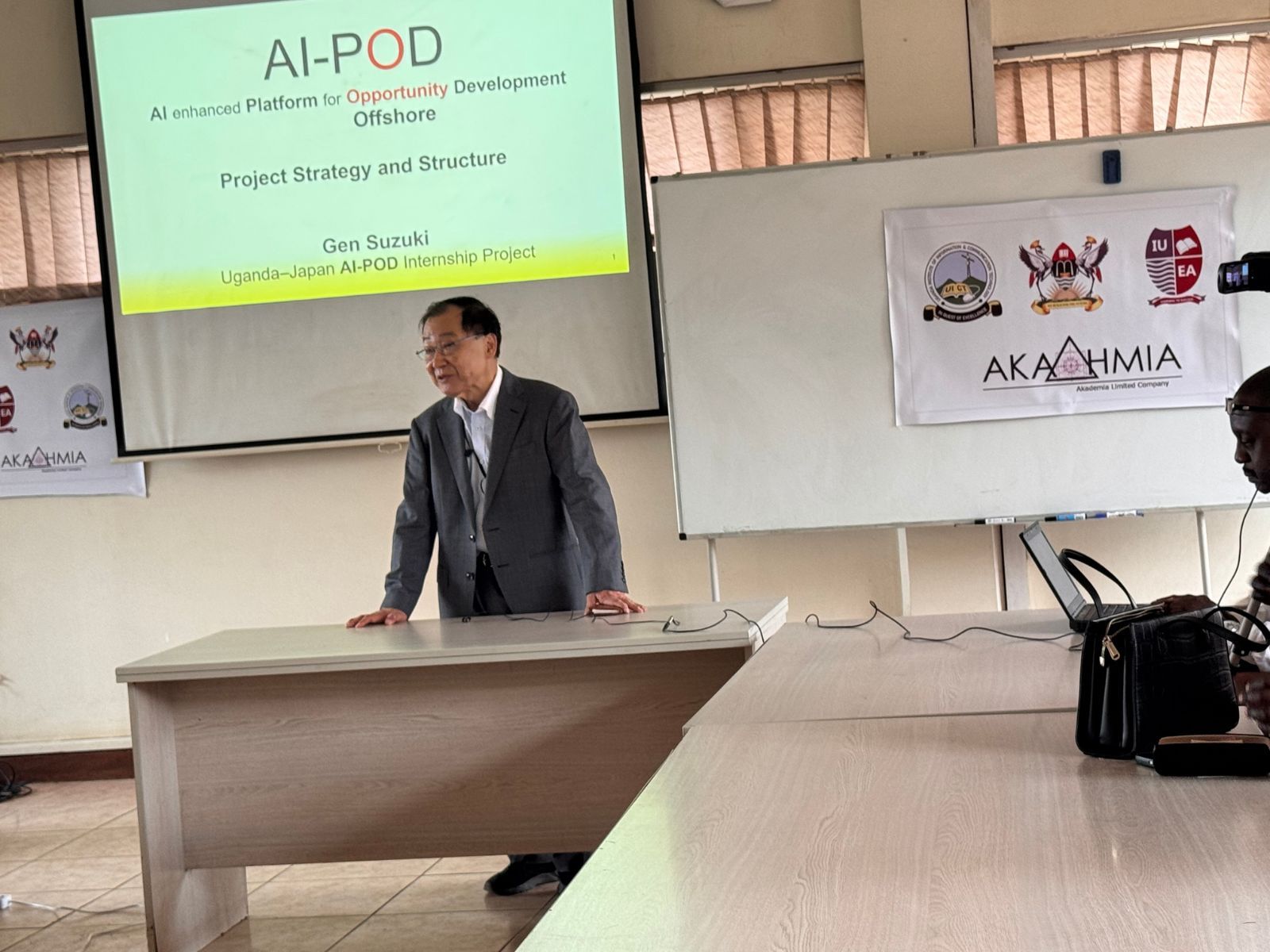


Makerere University buzzed with quiet energy this week as students, lecturers, government officials and industry guests gathered for the interim report of the Uganda–Japan AI-POD Internship Project.
The showcase offered a clear look at what a small group of Ugandan undergraduates and recent graduates have built in just a few months: practical artificial-intelligence tools designed to ease language barriers, improve remote teamwork and open doors to global work.
The AI-Enhanced Platform for Opportunity Development, or AI-POD, began earlier this year with 12 students. It has since grown to nearly 40 young innovators drawn from Makerere University, the Uganda Institute of Information and Communications Technology (UICT) and the International University of East Africa (IUEA).

Working in six teams, they have spent May to August developing systems that sit at the intersection of artificial intelligence and everyday business needs. The projects combine online mentoring with in-person sessions and draw technical guidance from Japanese partners.
Six concrete tools took centre stage. The AI Translation Checker, built at Makerere, automatically spots and corrects translation errors inside chat platforms such as Mattermost. Its goal is simple: reduce misunderstandings when Ugandan developers collaborate with overseas clients.
The AI-POD Daily Report System goes further. It interviews team members in their preferred language, analyses their daily activity and produces structured summaries for foreign partners—an attempt to bridge both language and cultural gaps that often slow offshore software work.
Other teams focused on presence and matching. The AI Avatar project creates three-dimensional digital characters that speak, lip-sync and gesture, giving remote interactions a more human feel. AI-World builds a virtual space where people and AI agents can meet, talk and negotiate.
At IUEA, the AI-DOJO team produced a conversation partner that role-plays business scenarios so users can practise international communication skills. UICT’s AI-Recruiter conducts structured interviews, evaluates résumés against job requirements and stays available around the clock.
Several of these platforms have reached the stage where pilot tests and early business trials can begin. The students’ demonstrations, including the AI-POD and UgaJapa presentations, showed how the same underlying technology can be applied to tourism guides, business-process outsourcing and other service sectors.
Robert Bob Okello, founder and chief executive of Maarifasasa Limited, delivered the keynote. He urged the young developers to treat Japan’s rising demand for digital talent as a concrete opportunity rather than a distant idea. Success, he said, will rest on professional habits, skills that match industry needs, closer ties between universities and companies, and reliable digital infrastructure.
Officials speaking for the Ministry of ICT and National Guidance welcomed the project’s focus on local talent and international partnerships. They repeated the ministry’s interest in programmes that turn student prototypes into businesses capable of creating jobs.
Behind the student work sits a deliberate strategy. Gen Suzuki, who outlined the project’s structure, framed the effort around a straightforward premise: artificial intelligence is reshaping work, and the people who learn to use it well will shape the outcomes.
Uganda, in this view, already possesses the raw material—intelligent, creative young people who are hungry for chances. The missing piece is structured opportunity. AI-POD tries to supply that piece by teaching participants how to build and apply AI tools that solve real communication and coordination problems.
The same presentation noted that a new company, DynaWisdom, has been formed to commercialise the technologies under local leadership, with Moses Musoke as president and a partnership link to Japan’s Akademia. The project’s public site, ai-pod.net, already lists the core platforms and invites further engagement.
What stands out after an afternoon of demonstrations is the practical tone of the work. None of the teams claimed to have invented artificial intelligence. Instead they concentrated on making existing capabilities useful for Ugandan developers who want to serve international clients without constant friction over language or reporting styles.
The daily-report system, for example, does not replace human managers; it reduces the time spent translating activity into formats foreign customers expect. The translation checker does not eliminate the need for skilled linguists; it catches routine errors before they become costly.
The interim showcase also underlined a wider pattern visible across Kampala’s tech circles. Universities are no longer content to teach theory alone. When they pair students with industry mentors and short, focused development cycles, prototypes appear faster and the path from classroom to pilot becomes shorter.
Whether these particular tools scale into sustained businesses will depend on the next rounds of testing, customer feedback and the ability of the new company to secure early contracts. Yet the existence of six working systems after only a few months already marks progress.


