

For decades, the logic behind much of conventional commercial lending in Uganda has been relatively straightforward. A business seeking significant financing demonstrates its financial history, presents predictable cash flows and, importantly, provides collateral against which a lender can secure the loan.
That model has financed businesses across the economy and remains an important part of prudent banking.
But what happens when the company asking for money owns few buildings or acres of land, yet has thousands of customers, valuable software, intellectual property, transaction data or a technology platform with significant commercial potential?

It is a question Uganda’s financial industry may increasingly have to answer as the country attempts to place science, technology and innovation at the centre of its long-term economic transformation.
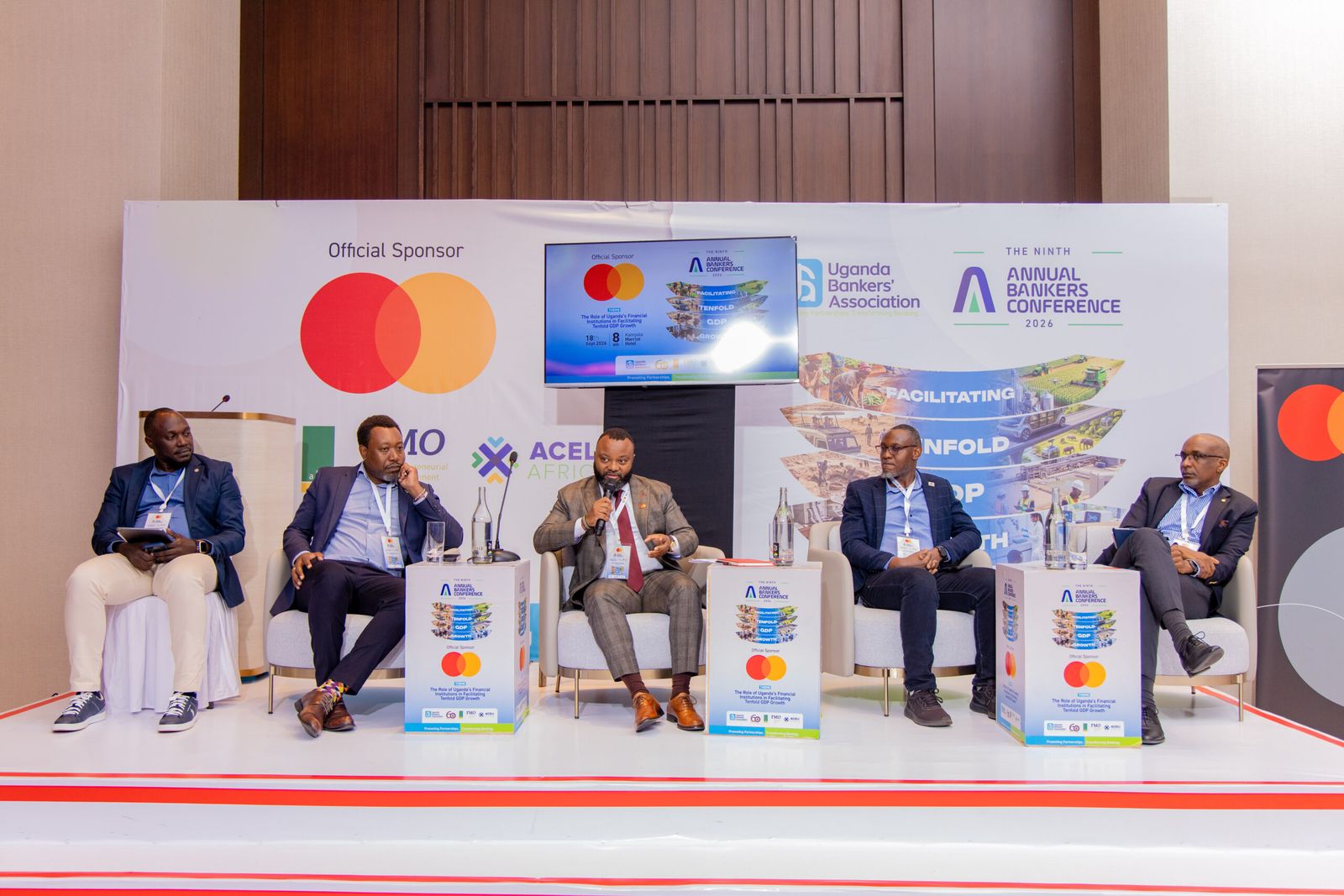
At the ninth Annual Bankers Conference in Kampala, the mismatch between conventional banking and the financing needs of the emerging digital economy became part of a much bigger conversation about Uganda’s ambition to expand its economy from roughly US$50 billion to US$500 billion by 2040.
The government’s strategy identifies agro-industrialisation, tourism, minerals — including oil and gas — and science, technology and innovation as the four principal engines of that growth.
Yet while the destination is ambitious, the discussion at the conference exposed an equally consequential question: does Uganda currently have the financial architecture required to pay for that transformation?
Uganda Bankers’ Association Chairman Michael Mugabi put the issue particularly sharply when discussing innovation.
“Tomorrow’s economy is being built around data, intellectual property and tech platforms.”
His point was made against a striking contrast. Traditional banking, Mugabi observed, has largely been constructed around collateral and historical cash flows. Financing innovation may therefore require lenders to rethink how they identify and price value in businesses whose most important assets cannot necessarily be mortgaged in the conventional sense.
When the asset is an idea
The challenge is not unique to Uganda, but it becomes increasingly important as the country attempts to make technology one of the engines of its economic growth.
A conventional manufacturer might own machinery, warehouses or land. A technology company, by comparison, could derive much of its value from proprietary software, algorithms, intellectual property, recurring digital revenues, customer relationships or the network it has built around its platform.
The distinction matters to a lender.
Uganda’s banking system cannot simply abandon collateral requirements or sound risk management. Banks hold depositors’ money and operate under prudential regulations intended to preserve the stability of the financial system.
The emerging argument is therefore not that traditional lending should disappear. Rather, financial institutions may need additional financing tools capable of assessing businesses differently.
Bank of Uganda Governor Michael Atingi-Ego addressed this directly, arguing that science, technology and innovation enterprises present a different financing problem from traditional sectors.
“These are enterprises whose real assets are cash flows and ideas rather than land titles.”
For such businesses, he suggested, the financing toolkit may have to include cash-flow lending, venture debt and intellectual-property finance, rather than relying exclusively on collateral-based models.
That distinction could prove important for Uganda’s technology ecosystem.
Startups frequently need capital before they have accumulated significant physical assets. Their value can be prospective rather than historical: what their technology could become, the customers it could acquire or the market it could address.
Banks, on the other hand, are structurally designed to ask a different set of questions. What happens if the borrower fails? What recoverable assets exist? How predictable are revenues? How much capital must the bank hold against the risk?
Bringing those two worlds closer together will require more than enthusiasm for innovation.
The UGX490 trillion challenge
The technology financing question forms part of a much larger capital challenge.
Uganda’s banking industry has committed to a response plan aimed at dramatically increasing financing available to the private sector. The ambition is for private-sector credit to rise to approximately UGX490 trillion by 2040.
The central bank has since asked supervised financial institutions to incorporate the ATMS sectors into their 2026/27 work plans and submit board-approved preparation strategies containing measurable performance targets.
But Atingi-Ego cautioned that announcing a credit target solves only one side of the equation.
Every loan a bank creates must ultimately be funded. Banks therefore have to consider how deposits, long-term funding and capital will expand alongside their lending ambitions.
“The journey to UGX490 trillion cannot be financed by ambition alone.”
For some institutions, the answer may lie in attracting new savers through technology. Others could seek longer-term funding, sustainable finance, strategic investment or capital-market issuance. Some may eventually need to consider public listings as a route to a broader investor base.
That creates an interesting intersection between technology and finance.
Digital technology can help financial institutions acquire customers more cheaply, reach previously underserved populations and mobilise deposits outside traditional branch networks. At the same time, technology businesses themselves need new forms of financing.
In other words, technology is both an instrument through which banks can expand their funding base and a sector requiring capital from those same banks.
Regulation versus innovation?
The obvious concern is whether asking banks to finance unfamiliar business models could encourage excessive risk-taking.
The central bank’s position at the conference was more nuanced.
Atingi-Ego argued that prudential regulation should not prevent financial institutions from taking strategic risks where those risks are supported by strong capital positions and sound risk management.
“Innovation within the framework is expected of you. Recklessness around it will not be tolerated.”
The Bank of Uganda, he said, intends to maintain proportionate, forward-looking regulation while enabling agent banking, digital distribution and responsible product innovation. The regulator also plans to strengthen areas including collateral registries, credit information and sectoral data while placing greater emphasis on cyber resilience.
That balance will be critical.
Too little innovation in financing could leave promising technology businesses unable to raise the capital required to scale. Too much poorly assessed risk could threaten financial stability.
The task is to build better ways of measuring risk rather than pretending it does not exist.
Data could change the credit equation
The government’s own remarks at the conference suggest that data could become increasingly important in that process.
The Minister of Finance called for improvements in credit assessment and greater use of data, specifically mentioning information from the Uganda Revenue Authority and National Identification and Registration Authority, subject to appropriate legal and regulatory frameworks.
Done carefully, richer financial and transactional information could potentially allow lenders to understand borrowers using more than physical collateral alone.
For smaller enterprises, that could become especially significant. A business may lack a large property portfolio but possess records demonstrating consistent revenues, tax compliance, transactions and customer activity.
But greater reliance on data also creates its own questions around privacy, consent, cybersecurity, data quality and how automated or data-assisted lending decisions are made.
Uganda’s challenge will therefore be to make financial data more useful without allowing the pursuit of easier credit assessment to outrun the safeguards surrounding personal and commercial information.
Banks may not be enough
There is another reality the conference repeatedly acknowledged: commercial banks cannot finance Uganda’s transformation on their own.
Mugabi’s “Business-Unusual” industry plan explicitly looks beyond bank credit to equity finance, pension reforms, diaspora capital, blended finance, venture funds, impact funds and sustainability finance.
Atingi-Ego similarly argued that pension funds, insurers, development finance institutions and capital markets will have to stand alongside banks as complementary sources of financing.
For technology companies, that broader ecosystem could ultimately prove more consequential than attempts to force every innovation into a traditional loan product.
A young software company may need equity. A more established technology business with recurring revenues could potentially use venture debt or cash-flow lending. A mature company might eventually raise capital from public markets.
The real transformation, therefore, may be the emergence of a financing continuum rather than a single new banking product.
From lender to financial architect
That would also change the role of banks themselves.
Atingi-Ego challenged financial institutions to evolve “from lenders to arrangers” and from transaction bankers into strategic partners capable of connecting businesses to different pools of capital.
It is a subtle but significant shift.
A bank may not always need to place an entire financing requirement on its own balance sheet. It could structure transactions, participate in syndications, connect projects to institutional investors or work with development finance institutions to share risk.
For Uganda’s technology sector, that may be the more realistic route toward unlocking capital at scale.
The country does not need its banks to suddenly behave like venture capital firms. It needs a financial ecosystem capable of recognising that financing a software platform, an agro-processing plant and an oil infrastructure project requires different risk models, different capital and different time horizons.
That is why one of the most consequential questions to emerge from the ninth Annual Bankers Conference was not simply how much Uganda’s banks are prepared to lend.
It was whether the institutions that financed yesterday’s economy can redesign themselves for tomorrow’s.


