

For years, the story of technology in Uganda’s financial sector has largely been told through mobile money, digital banking apps, cashless payments and the steady migration of everyday transactions from banking halls to phones.
The next phase could be considerably more demanding.
Uganda’s financial institutions are now being asked to consider how technology, capital markets and new financing models can help bankroll an economy that intends to become roughly ten times larger over the next decade and a half.

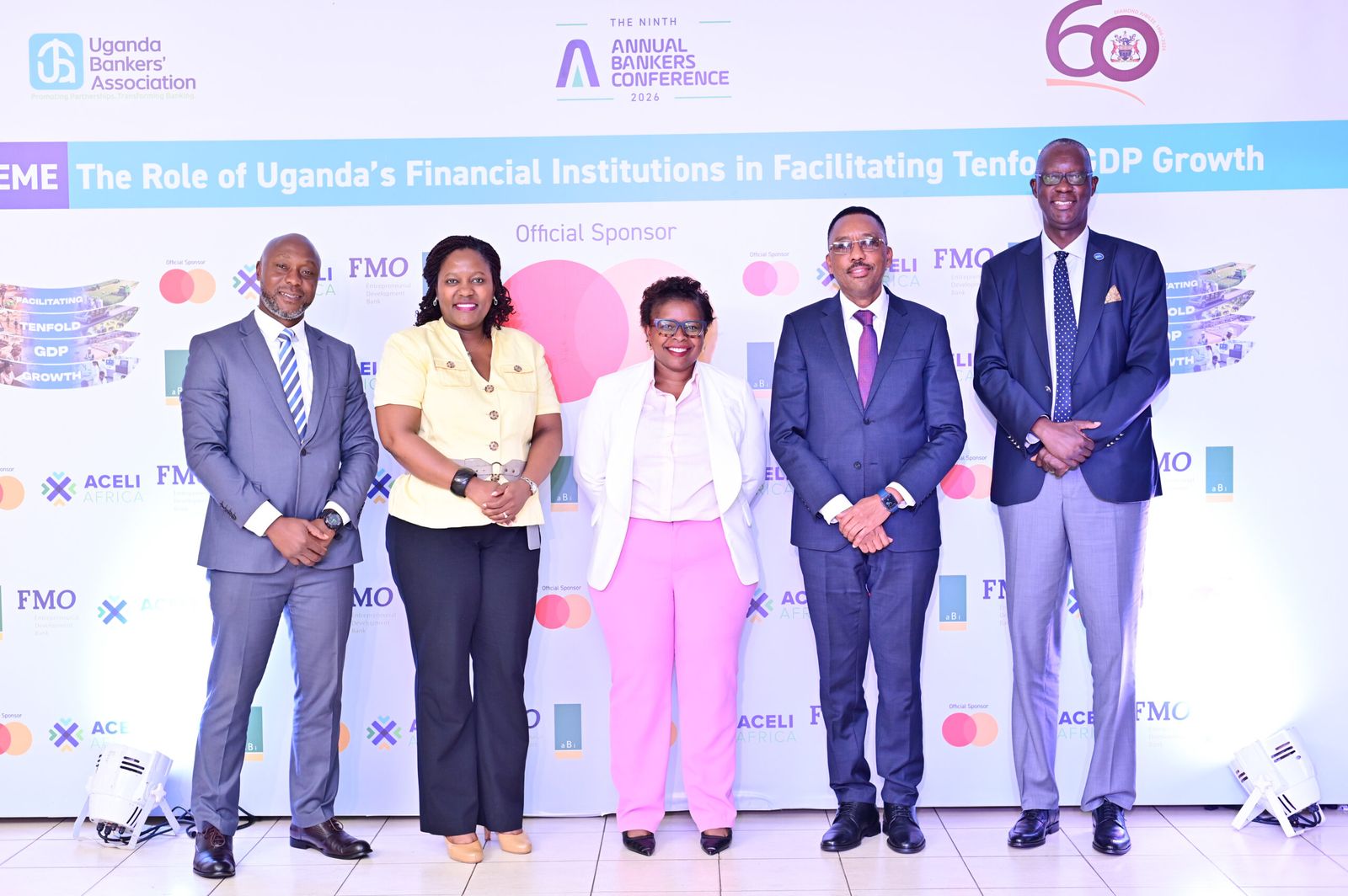
That challenge will sit at the centre of the 9th Annual Bankers Conference, scheduled for September 18, 2026, at the Kampala Marriott Hotel. Convened by the Uganda Bankers’ Association in collaboration with the Bank of Uganda, Mastercard and other partners, this year’s conference will run under the theme, “The Role of Uganda’s Financial Institutions in Facilitating Tenfold GDP Growth.”
It is an ambitious conversation because the economic target itself is ambitious.
Under Uganda’s Tenfold Economic Growth Strategy and the Fourth National Development Plan, the government wants to grow the country’s GDP from approximately US$50 billion to US$500 billion by 2040. The growth strategy is anchored around four broad areas commonly grouped under the ATMS framework: agro-industrialisation, tourism, mineral-based industrial development including oil and gas, and science, technology and innovation.
For banks, fintech firms, payment companies, regulators and capital-market players, the question is therefore moving beyond whether Uganda needs more financing. It is becoming a question of what kind of financing, for which sectors, over what period, and supported by what technology.
From traditional lending to growth infrastructure
Uganda Bankers’ Association Chairperson Michael Mugabi has framed the moment as one requiring the financial sector to move beyond its traditional role.
“The financial sector must evolve from traditional lending to becoming a deliberate, proactive engine for national growth.”
His argument is that capital, policy and market infrastructure will have to become much more deliberately aligned if financial institutions are to materially support the tenfold growth ambition.
That shift matters because many of the projects expected to drive Uganda’s next phase of growth do not fit neatly within conventional short- and medium-term commercial lending.
Mining infrastructure, oil and gas development, major agro-processing facilities, transport networks, tourism assets and technology ventures can require large volumes of capital whose repayment horizons stretch over many years. In some cases, the risks associated with early-stage industries or infrastructure projects can also make conventional debt either expensive or difficult to secure.
The banking sector is therefore looking at a broader funding architecture.
According to Mugabi, the industry has developed a response strategy that envisages significantly increasing private sector credit, with an ambition to expand it to UGX490 trillion by 2040. The approach is expected to rely on innovative financial intermediation, partnerships and wider market reforms.
At the same time, the Association acknowledges that commercial banks cannot shoulder the financing requirements alone. Capital markets, domestic and international investors, development finance institutions and other sources of patient and structured capital will have to play a much larger role.
This is one of the more important shifts in the conversation.
Rather than seeing banks simply as lenders, the emerging view places financial institutions within a larger network that can structure deals, share risk, connect projects with investors and help attract longer-term capital.
Wilbrod Owor, Executive Director of the Uganda Bankers’ Association, says getting that financing model right will determine whether capital reaches the sectors expected to carry the next wave of growth.
“Our focus is squarely on how to de-risk extension of much more credit to the key ATMS sectors.”
Owor argues that an effective financing model should ultimately translate into employment, stronger export revenues and broader economic prosperity.
Technology moves from convenience to economic infrastructure
For a technology audience, perhaps the most significant part of this year’s agenda is the growing recognition that digital financial infrastructure can no longer be treated merely as a consumer convenience.
Technology is increasingly being presented as part of the economic infrastructure required to support Uganda’s growth ambitions.
One of the four major conference discussions will specifically examine Science, Technology and Innovation Financing, with the wider programme also expected to consider home-grown ICT initiatives and financing models suited to Uganda’s relatively young population.
That raises a longstanding challenge.
Uganda has a growing technology and startup ecosystem, but financing innovation is structurally different from financing established businesses with predictable revenues and physical collateral.
Early-stage technology companies may possess intellectual property, user growth, software platforms or future revenue potential, but relatively few conventional assets that a bank can easily secure against a loan.
If science, technology and innovation are to become meaningful contributors to tenfold economic growth, financial products will consequently have to evolve alongside the companies they are expected to fund.
This could mean greater use of blended finance, guarantees, venture and growth capital, development finance and other forms of risk-sharing — alongside conventional banking.
It is also where the private sector’s digital infrastructure providers see a role for themselves.
Victor Ndlovu, Mastercard’s Vice President and Head of Business Development for East Africa, describes the tenfold growth objective as requiring more than additional lending.
“Financing growth is about more than traditional lending. It requires new approaches to capital, greater use of technology and stronger collaboration.”
Ndlovu argues that Uganda will need financial systems capable of supporting enterprises at different points in their development — from entrepreneurs trying to scale, to exporters entering new markets and investors backing the next generation of innovation.
Digital payments as an entry point
Part of Mastercard’s argument is built around the idea that digital payments can draw businesses and consumers deeper into the formal economy.
When businesses can transact securely and efficiently, they potentially create more visible financial histories. That data can, in turn, improve how institutions understand customers, assess businesses and design financial products.
Mastercard says its current work in Uganda includes supporting the digitalisation of payments, expanding financial inclusion and helping businesses participate more fully in the digital economy.
The company highlights its collaboration with Uganda’s Ministry of ICT and National Guidance in support of the Digital Uganda Vision, where it is providing technical expertise intended to help modernise the country’s digital payments ecosystem. This includes efforts to make digital payments more accessible to micro and small merchants and create pathways for greater participation in e-commerce and the wider digital economy.
The company also points to several recent collaborations as examples of how this infrastructure is taking practical form.
In 2025, Mastercard worked with MTN MoMo Uganda, Diamond Trust Bank and Network International to launch the Virtual Card by MoMo, allowing mobile money users to make secure online payments without requiring a physical card or traditional bank account. The initiative potentially opens another route into e-commerce for consumers who have historically operated outside card-based payments.
Mastercard is also working with Equity Bank Uganda to extend financial services to digitally underserved individuals, communities and businesses. Through Mastercard’s Community Pass, the collaboration supports financial inclusion cards that can allow users to save and spend securely, establish digital credentials, access credit and connect to essential services.
Another collaboration with I&M Bank Uganda has introduced a range of Mastercard debit cards, aimed at giving customers more secure and convenient digital payment options.
These initiatives illustrate an important point: Uganda’s growth story will not be driven only by financing multimillion-dollar infrastructure projects. It will also depend on whether smaller businesses and ordinary consumers can enter and participate effectively in an increasingly digital economy.
From conference conversation to execution
For the Annual Bankers Conference, now in its ninth edition, the September gathering comes at a point when Uganda’s financial sector is being asked to tackle questions that stretch well beyond banking.
For the past eight years, the conference has provided a platform bringing together policymakers, financial institutions, development partners, the private sector, academia, industry associations and civil society to consider the role of the financial ecosystem in economic development.
The challenge for the ninth edition will be turning a compelling national ambition into practical financial mechanisms.
Uganda wants a dramatically larger economy. Achieving that objective will require considerably more capital, more sophisticated financial markets, stronger digital infrastructure and financing instruments capable of accommodating projects that conventional commercial banking was not necessarily designed to support.
It will also require financial institutions themselves to evolve.
Mastercard’s Ndlovu captures the shift succinctly: Uganda needs a financial sector that is “not simply responding to economic growth but actively enabling it.”
That means technology will have to do more than make existing banking services faster or more convenient. It will have to connect businesses to markets, widen participation in the formal economy, strengthen digital commerce and help financial institutions find new ways of connecting capital with opportunity.
Patient capital, meanwhile, will need to move from conference vocabulary into actual financing structures capable of supporting mining, energy, tourism, agro-industrialisation and innovation over the longer term.


