

For many Ugandans, the smartphone has quietly become much more than a telephone.
It is a bank branch in a pocket, a classroom on the morning commute, a camera for a budding content creator, a shopfront for a small business and, increasingly, an office for people whose work happens wherever they happen to be.
That changing relationship between people and their devices provides useful context for what TECNO is preparing to showcase at IFA ShowStoppers 2026 in Berlin this September.

The technology company will arrive with a broad portfolio spanning smartphones, laptops, tablets, wearables and audio devices. But behind the specifications and futuristic designs is a bigger story about how consumer technology is evolving: the boundaries between the phone, computer, entertainment device and creative tool are becoming increasingly blurred.
For Uganda, where smartphone adoption and internet use continue to grow, that evolution is particularly relevant.
Figures from the Uganda Communications Commission show just how quickly the country’s digital landscape is changing. By December 2025, Uganda had approximately 20 million smartphones, up from 17.6 million only six months earlier. Active mobile internet subscriptions stood at 18.5 million.
The numbers are impressive, but they also tell only part of the story. Affordability, digital skills, connectivity and the cost of data continue to determine who can meaningfully participate in the digital economy.
It is against this backdrop that TECNO’s latest technology becomes interesting.
The disappearing edge
The device likely to attract the most attention in Berlin is not yet a phone consumers can walk into a shop and buy.
TECNO’s Next-Gen Bezelless Concept Phone is an experiment in removing one of the final physical boundaries of modern smartphone design: the thin black border surrounding the display.
Phone manufacturers have spent years shrinking bezels to create larger screens without dramatically increasing the overall size of devices. Even on today’s premium phones, however, a narrow border generally remains between the active screen and the outer frame.
TECNO says its concept reduces that visible display border to 0mm.
Achieving this, according to the company, required changes to the internal arrangement of components, structural engineering and screen packaging.
The result is a display that appears to run directly into the phone’s frame.
It sounds like a small change measured in millimetres, but smartphone design has increasingly become a contest over such details. As processing power, cameras and displays improve across competing brands, manufacturers are searching for new ways to make devices feel different.
There is, however, an important distinction: this remains a concept phone.
The company has not announced a commercial release date, price or complete hardware specifications. Independent observers will also be interested in questions that become important once the novelty wears off: How durable is a screen with virtually no protective border? How well does it survive drops? Does removing the bezel meaningfully improve everyday use?
Those questions matter particularly in markets such as Uganda, where consumers often expect a smartphone to survive years of intensive use rather than simply deliver an impressive design.
Concept devices nevertheless have a role. They allow manufacturers to test ideas that can eventually filter into mainstream products.
The laptop is changing too
TECNO is taking a similar approach to personal computing.
Among three MEGABOOK laptops heading to Berlin, the MEGABOOK T15 360 Pro perhaps best captures how manufacturers see the computer evolving.
TECNO’s first laptop combining a 360-degree hinge and 10-point touchscreen can move between the familiar laptop configuration and other forms suited to presentations, watching video, drawing or touchscreen interaction.
The Pro model adds a 15.6-inch 2.5K 120Hz touchscreen and optional active pen support, while Intel Core Ultra processing with an integrated neural processing unit reflects another major industry trend: bringing more artificial intelligence processing directly onto personal devices.
For a university student, for example, the same machine could theoretically move from typing an assignment to annotating notes and then streaming a film. For a designer or entrepreneur, it could move between presentation, sketching and conventional desktop work.
TECNO is also widening the range.
The MEGABOOK K15S WCL is positioned toward more cost-conscious everyday users, while the MEGABOOK T17 Ultra moves in the opposite direction, offering the company’s first 17-inch laptop, a 99.99Wh battery and 100W GaN fast charging for people who want more screen space and performance.
The range illustrates an increasingly important reality in emerging technology markets: innovation cannot exist only at the premium end.
Technology as identity
Another part of TECNO’s Berlin showcase reflects something different altogether: consumers increasingly buy technology not only for what it does, but also for what it says about them.
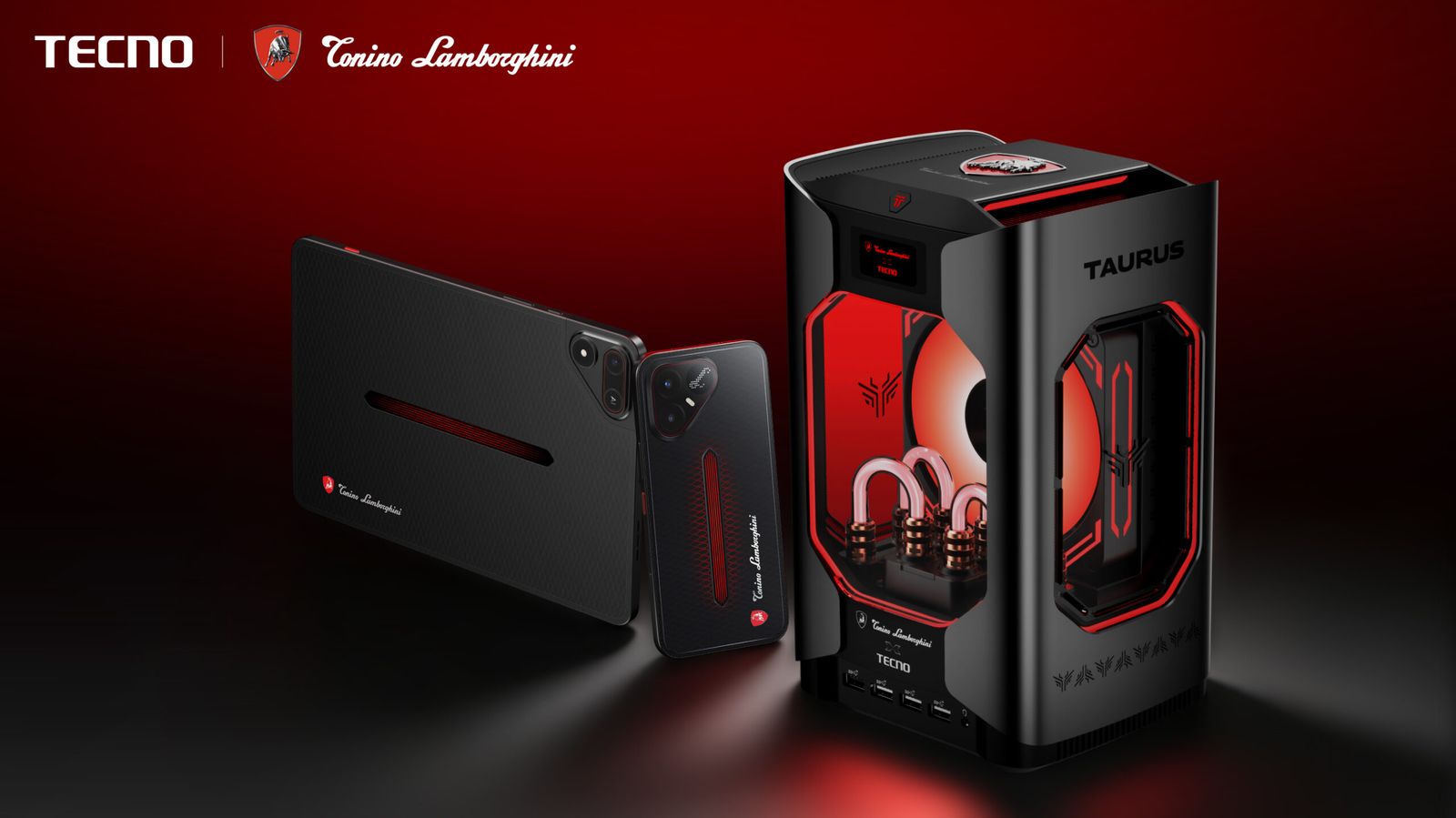
TECNO’s collaboration with Italian lifestyle brand Tonino Lamborghini brings that idea into the POVA 8 Pro 5G Tonino Lamborghini Limited Edition.
The phone combines styling inspired by the Italian brand with a MediaTek Dimensity 7400 Ultimate 5G processor, a 50MP Sony LYTIA-powered main camera, a 144Hz AMOLED display and a 6,500mAh battery.
It is an unusual meeting point between fashion, gaming culture and mobile technology.
The partnership extends to the MEGAPAD 2 Tonino Lamborghini Limited Edition and the TAURUS — also known as the MEGA MINI G1 Pro — a compact water-cooled gaming PC.
Whether such limited editions become mainstream products is less important than the consumer behaviour behind them. Phones, headphones and laptops are increasingly personal accessories in much the same way watches and clothing have long been.
For younger consumers especially, design has become part of the technology experience.
From devices to ecosystems
TECNO’s wider IFA portfolio also includes the CAMON Slim 5G, CAMON Slim, MEGAPAD SE 2 tablet, Watch 4 smartwatch and Buds 5 wireless earphones.
Individually, none tells the whole story.
Together, they demonstrate the industry’s movement away from selling isolated devices towards creating connected ecosystems around users.
The CAMON Slim models focus heavily on portability, photography and AI-assisted experiences within a 6.39mm body. The MEGAPAD SE 2 is positioned around learning and AI-supported study. Watch 4 extends the ecosystem into fitness and outdoor activities, while Buds 5 promise up to 50 hours of listening time, with a charging case that can double as a phone stand.
That may sound like a collection of conveniences, but it reflects how people’s expectations have changed.
A phone is expected to communicate with a watch. Earphones move between calls, music and online meetings. Tablets are expected to handle education as comfortably as entertainment. Computers increasingly need to accommodate both conventional work and AI-assisted tasks.


