

For a technology brand, an international trade show is about more than showing off new gadgets. It is an opportunity to make a statement about where the industry is heading — and where the company believes it belongs.
At IFA 2026 in Berlin, TECNO appeared to have a particularly clear answer.
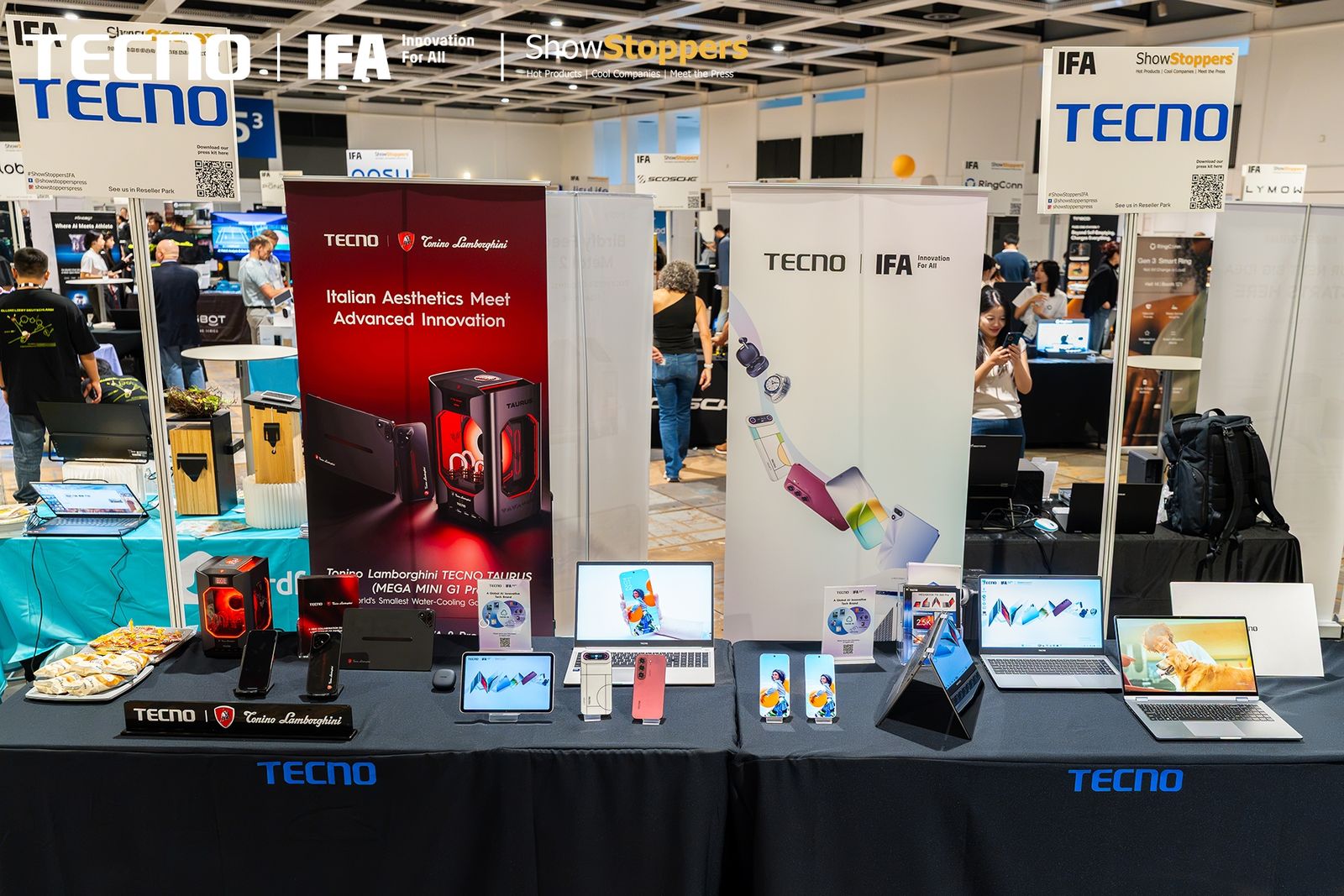
The company arrived with smartphones, laptops, a gaming PC and experimental technology, but the bigger story was the breadth of the portfolio. Once known primarily for its smartphones, TECNO is increasingly presenting itself as a technology company interested in the spaces where mobile computing, artificial intelligence, design and entertainment meet.

That ambition received an early boost at the show when two TECNO products were recognised with IFA Global Product Technology Innovation Gold Awards.
The awards went to the TECNO Modular Phone and the Tonino Lamborghini TECNO TAURUS (MEGA MINI G1 Pro), recognising two very different approaches to innovation — one focused on making a smartphone more adaptable, the other on packing serious computing and gaming capability into a remarkably compact machine.
Around them was a collection of products that offered a broader glimpse of TECNO’s direction, including its Next-Gen Bezelless Concept Phone, the MEGABOOK T15 360 Series, MEGABOOK K15S WCL, MEGABOOK T17 Ultra, CAMON Slim 5G and POVA 8 Pro 5G Tonino Lamborghini Limited Edition.
Taken together, the showcase suggested that TECNO is no longer content to compete only on the conventional smartphone battlefield.
Two awards, two very different ideas
The TECNO Modular Phone is perhaps the clearest example of the company’s willingness to question familiar assumptions about what a smartphone should be.
At 4.9mm, TECNO describes it as the world’s slimmest modular smartphone. Its defining feature, however, is not simply its thinness.
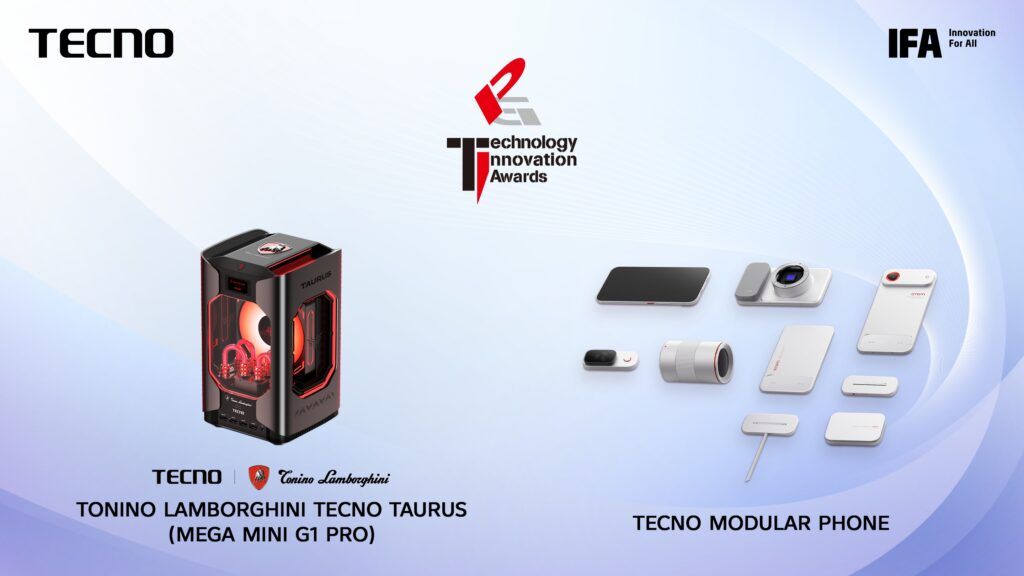
The phone uses what TECNO calls Modular Magnetic Interconnection Technology, combining a magnetic array with pogo-pin connectors to allow different modules to attach to the device. The concept has been developed around ten high-performance modules, giving users the possibility of changing the phone’s capabilities depending on their needs.
It is an interesting proposition at a time when smartphones can sometimes feel increasingly similar.
The industry has become very good at producing thinner bezels, better cameras and faster processors. Modular hardware introduces a different question: what if the phone itself could change?
The concept has already attracted attention beyond TECNO’s own marketing. The company says the Modular Phone received more than 20 accolades from international technology publications following its appearance at MWC 2026, including recognition from CNET, Yanko Design and The Verge.
Its IFA recognition adds another layer to that story.
The second award went to the Tonino Lamborghini TECNO TAURUS, a compact gaming PC that combines high-performance computing with a design-led approach.
At approximately 6.36 litres, the machine houses an Intel Core i9-13900HK processor, NVIDIA GeForce RTX 5060 graphics, water cooling and 15 ports, including OCuLink and USB4.
The significance is less about simply making a powerful computer smaller and more about the direction of personal computing. Consumers increasingly want devices that can occupy less physical space without necessarily forcing them to compromise on performance.
When a screen has nowhere left to go
If the Modular Phone represents one possible future for smartphone hardware, TECNO’s Next-Gen Bezelless Concept Phone explores another: what happens when the border around the screen effectively disappears?
The device became one of the most talked-about products at TECNO’s IFA showcase with its claimed true 0mm display border.
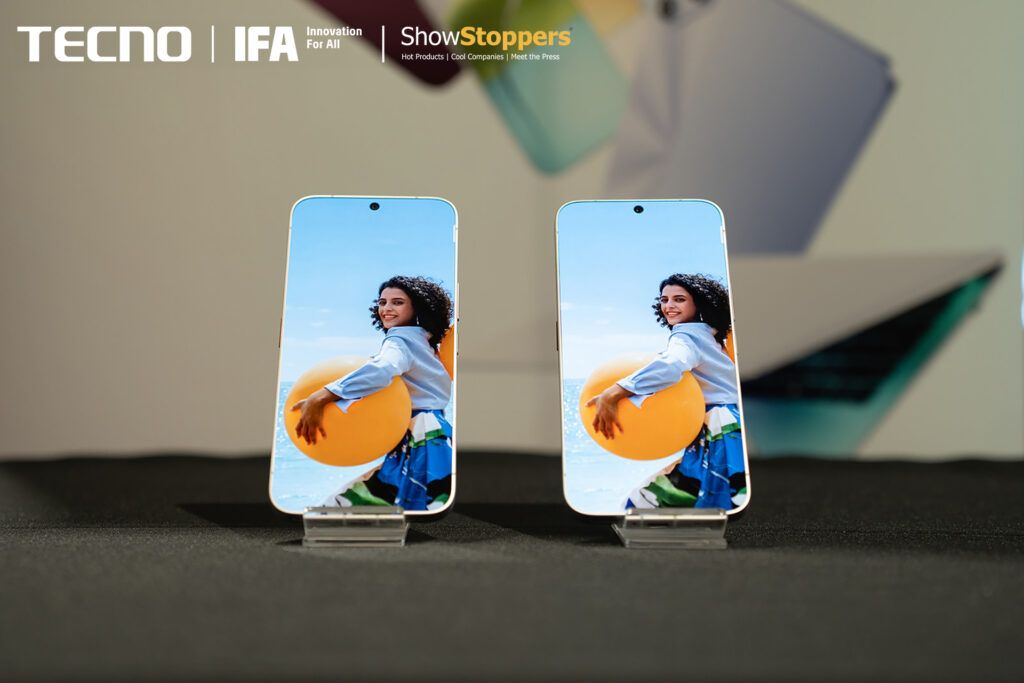
Modern smartphones have spent years pushing screens closer to their edges. Even the most advanced designs generally retain a narrow black area separating the active display from the frame.
TECNO says it has removed that final visible boundary through changes to display architecture, internal stacking, structural engineering and screen packaging.
The result is a phone whose screen appears to extend continuously to the edge.
On paper, the difference may sound almost insignificant. In the hand, however, the effect is easier to understand.
Technology creator Marques Brownlee, better known as MKBHD, had an early hands-on experience with the device and described it simply as, “It’s kind of surreal.”
That reaction captures something important about concept technology. Specifications can explain what a device achieves, but physically seeing it can communicate the idea much more effectively.
The 0mm phone is still a concept rather than a conventional mass-market product, and that distinction matters. Questions around durability, manufacturing complexity, cost and everyday practicality will ultimately determine whether such technology moves beyond the demonstration stage.
For TECNO, however, the exercise provides an opportunity to explore technologies that could eventually influence other products — from touch responsiveness and cameras to sound and user-interface interactions.
The laptop gets a new role
TECNO’s expansion is perhaps most visible in its MEGABOOK range.
The MEGABOOK T15 360 Series, comprising the T15 360 and T15 360 Pro, is the company’s first laptop series with a 360-degree hinge and touchscreen support.
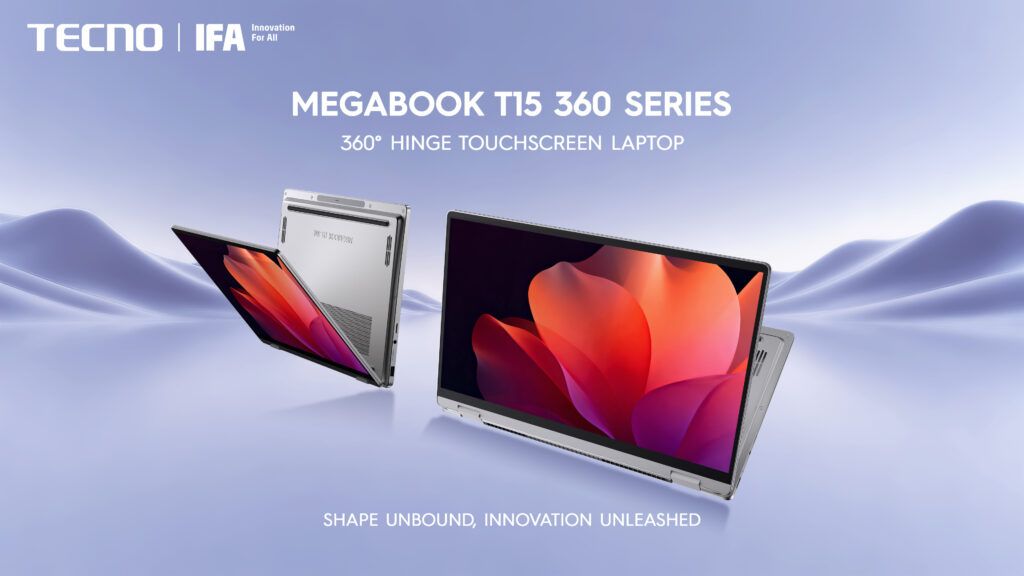
The idea is straightforward: one computer that can change according to the situation.
In Laptop Mode, it functions like a conventional computer. Rotate the screen and it becomes a tablet for note-taking or touch interaction. Tent Mode makes it easier to consume content where desk space is limited, while Stand Mode can be useful for presentations and shared viewing.
The T15 360 Pro takes the hardware further with a 15.6-inch 2.5K 120Hz touchscreen, while the range can be configured with up to an Intel Core Ultra 9 185H processor, LPDDR5X memory and PCIe SSD storage.
A 70Wh battery and 65W GaN charging are designed to support users who work away from a fixed desk.
The significance of such a machine is not simply that the screen folds backwards.
It reflects how the definition of a workplace has changed.
For a university student, the laptop may be a classroom in the morning and an entertainment device at night. For an entrepreneur, it may serve as an office, presentation tool and content-creation machine. For a professional, it may need to move seamlessly from a meeting room to a flight or a café.
The computer is increasingly expected to adapt to the user.
TECNO’s other MEGABOOK launches reinforce that strategy. The K15S WCL is aimed at users looking for everyday performance and value, particularly students and early-career professionals, while the larger 17.3-inch T17 Ultra is designed for consumers who prioritise screen size and performance.
It is a reminder that the future of computing will not be defined by one type of user.
Performance, personality and the smartphone
The smartphone remains central to TECNO’s business, but even here the company is pursuing different interpretations of what consumers want.
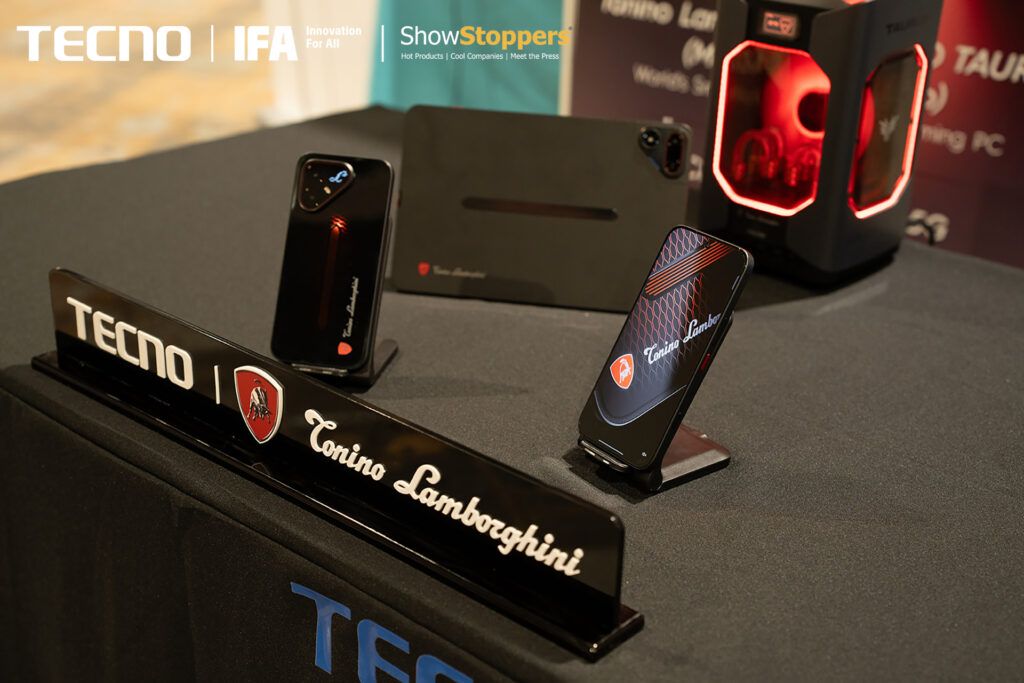
The POVA 8 Pro 5G Tonino Lamborghini Limited Edition brings together POVA’s performance-oriented identity with the visual character of the Italian Tonino Lamborghini brand.
Its dual-chipset architecture combines the MediaTek Dimensity 7400 Ultimate 5G platform with TECNO’s P1 Graphic Chip, supported by a 5K IceShield Vapor Chamber Cooling System.
The partnership also reflects another development in the smartphone market: phones increasingly function as expressions of identity.
Consumers are not necessarily choosing between devices based only on processor speeds or camera megapixels. Design, gaming credentials, brand associations and the feeling a product creates can be just as important.
The CAMON Slim 5G takes a different route.
At 6.39mm, the device places portability and design alongside CAMON’s established focus on imaging. It combines a slim form factor with pro-level imaging capabilities, AI features and distinctive colour treatments.
Together, the two smartphones demonstrate how the same company can target very different lifestyles — one built around performance and gaming, the other around photography, style and everyday mobility.


