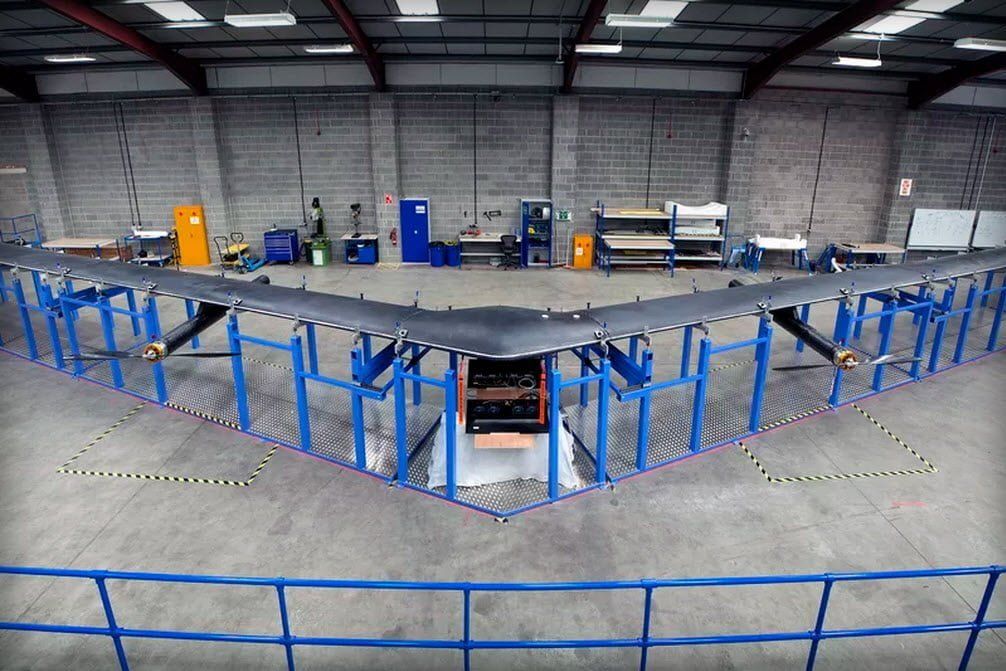


We have talked about flying internet service providers that what to improve access to internet especially for developing nations, from Google’s internet balloons to Facebook’s Internet powered drones all these giant companies want is to tap into the next billion internet users. Facebook today introduced Aquila, a high-flying, long-endurance plane that will bring basic internet access to the developing world and has shown off a working model of the plane that will soon lift off for initial testing.
The V-shaped plane has the wingspan of a Boeing 737. It comes equipped with the necessary communications gear, It only weighs between 400 to 453 Kgs— according to Facebook Aquila will be able to circle a remote region for up to 90 days, beaming connectivity down to people from an altitude of 60,000 to 90,000, when deployed. This means the planes will be flying at an altitude above commercial aircraft, and even above the weather. So less need for regulation from international Air space.
How will it work?
Facebook’s blog says that it will have lasers on the ground that can locate the dome-shaped optical head located on the bottom of the plane in the air — basically shooting a laser at a dime-sized target that is more than 10 miles away. The plane will first hone in on the general location of the laser on the ground, proceeding to target it further and lock onto the location so that it can start beaming down the internet. Because the plane requires a connection with the lasers on the ground though, you might experience a slower connection when it’s raining or cloudy.

The plane is built from two layers of lightweight carbon fiber material that sandwich a layer of foam. The planes are intended to stay afloat for three months at a time — presently the record for an aircraft staying afloat is two weeks — which is why the entire outside shell will be covered in solar panels. During the day, when they are fully charged, the planes will fly at an altitude of 90,000 feet. But at night, in order to conserve power, they’ll float down to about 60,000 feet, going back up again the following day. This ensures a constant connection to the Internet, because they do not need to come down to be charged.
Lasers can deliver 10s of gigabytes per second
The company feel it has achieved a huge breakthrough in the speed and accuracy of how these lasers work — they’ve lab-tested a laser that can deliver data at 10s of gigabytes per second, which is 10 times faster than the current state-of-the-art in the industry. The social giant is still planning to use its Aquila fleet to create a mesh network that will bring internet access to rural areas. Just like its internet.org project, Facebook won’t provide access directly, and will instead partner with local mobile networks. You can check the source link below for more.


