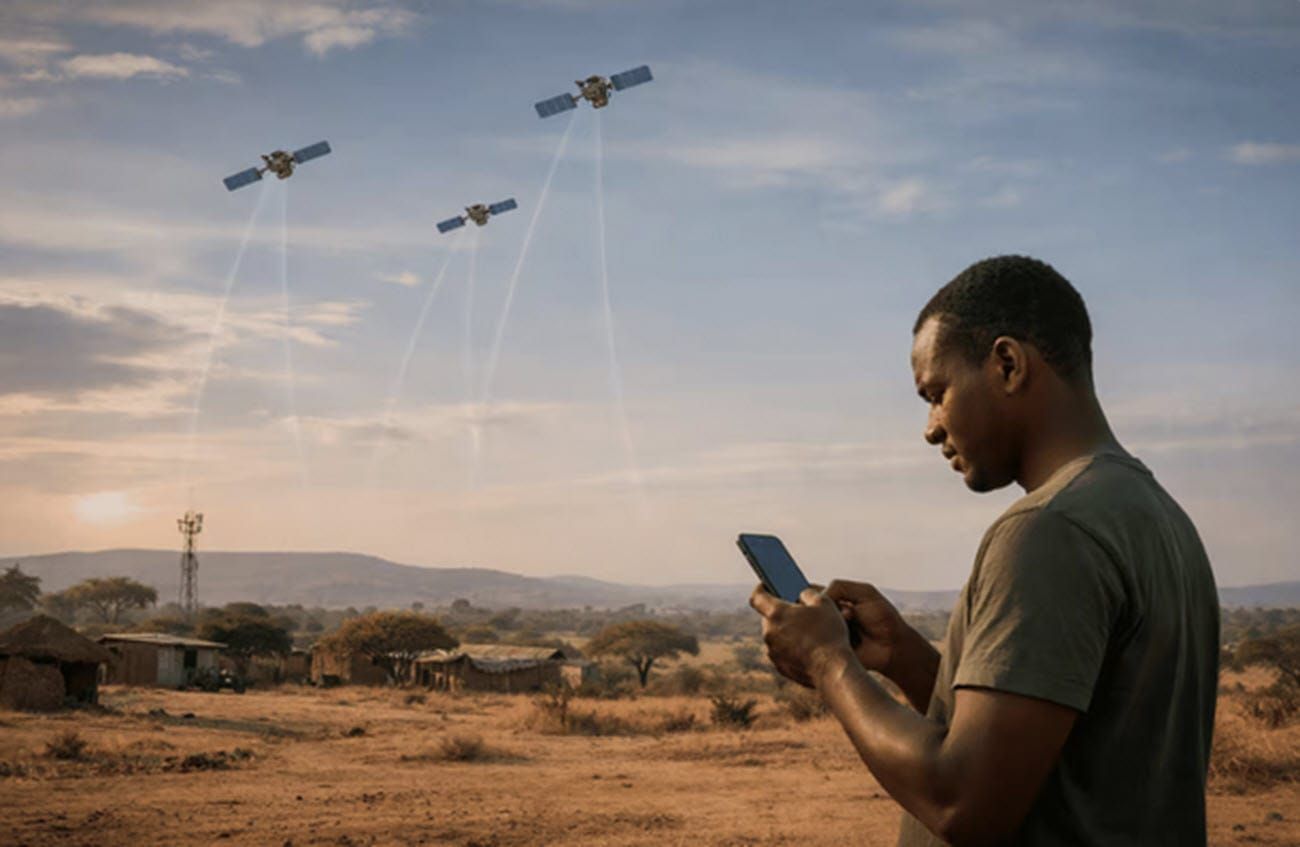


Airtel Uganda has officially begun testing Starlink’s Direct-to-Cell satellite service, marking a significant step toward solving one of the country’s biggest connectivity challenges: reaching remote and underserved areas where traditional cell towers are impractical or impossible to build.
The trials were approved by the Uganda Communications Commission (UCC) shortly after the Ugandan government cleared Starlink for commercial operations in the country. This positions Airtel Uganda among the first operators in Africa to test the cutting-edge technology.
ALSO READ: Starlink officially lands in Uganda. Here’s all you need to know

Direct-to-Cell, also referred to as Direct-to-Device or Supplemental Coverage from Space, essentially turns Starlink’s low-Earth orbit satellites into orbiting cell towers. Compatible smartphones can connect directly to these satellites without any special hardware, antennas, or modifications. The initial phase focuses on voice calls, SMS, and limited data services, with full mobile broadband expected in later stages.
Speaking on the development, Airtel Uganda CEO and Managing Director Soumendra Sahu expressed strong optimism:
“Today, we are pleased to begin our journey of exploring our long-awaited partnership with Starlink. This marks the start of testing a highly advanced technology that enhances smartphone network connectivity through Direct-to-Cell satellite services.”
Sahu highlighted specific locations that stand to benefit dramatically, including the Buvuma Islands and Murchison Falls National Park, where conventional infrastructure deployment remains extremely difficult.
“This service is a game changer in extending connectivity to remote and hard-to-reach areas. The technology automatically links smartphones to satellites, improving access to calls, text messaging and selected data services.”
The initiative stems from a broader partnership between Airtel Africa and SpaceX, aimed at rolling out Direct-to-Cell connectivity across 14 markets serving over 174 million customers. Airtel Uganda’s early testing puts it at the forefront of satellite-cellular integration on the continent. The service is powered by Starlink’s rapidly expanding constellation of more than 650 satellites.At a time when many operators are still focused purely on terrestrial 4G and 5G expansion, Airtel’s move represents a hybrid strategy: combining ground-based infrastructure with space-based coverage. The company recently added 258 new 4G sites and expanded its 5G footprint to 364 sites across major urban centers including Kampala, Jinja, Mbale, Masaka, Lira, Fort Portal, Gulu, and Mbarara.Sahu concluded by framing the project as part of Airtel’s wider commitment to digital inclusion:
“At Airtel, we continue to leverage advanced technology not only to improve our network and services but also to solve real challenges within the communities we serve. Through Direct-to-Cell services, underserved communities across Uganda will enjoy seamless connectivity, enabling them to stay connected with loved ones and access opportunities for business and growth.”
If successful, the Starlink Direct-to-Cell integration could significantly narrow Uganda’s digital divide, bringing reliable communication to national parks, islands, mountainous regions, and rural communities that have long been left behind by traditional networks. Industry watchers will be closely monitoring the trial results, as this technology could become a blueprint for mobile operators across Africa and other emerging markets.


