


Airtel Uganda, one of the country’s top mobile and internet providers, just shared its financial results for the full year 2025 (ending December 31). The numbers show something exciting: Ugandans are using way more mobile data than ever before, and it’s paying off big time for the company.
The company‘s profit after taxes jumped by an impressive 41.1%, reaching UGX 446.9 billion. That’s a huge increase compared to the year before. This growth came mainly from people shifting to data-heavy activities like browsing, streaming, social media, and mobile money, plus smart ways the company kept its costs under control.
ALSO READ: How noise cancellation really works

Even though regulators cut some call connection fees (from UGX 45 to UGX 26 per call last year), Airtel still did really well. This shows how strong the business has become. Here’s the big milestone: For the first time in Uganda’s telecom industry, data revenue beat voice (call) revenue. Data brought in UGX 1,101.7 billion, while voice brought in UGX 1,026.8 billion (note: some reports show slight variations in voice figures, but data clearly took the lead). Data revenue grew by 22.4% during the year. This happened because:
- More people signed up for data plans (data customers up 19.6%).
- Existing users consumed more data (usage per person up 14.8%).
Overall company revenue grew 13.3%, and earnings before interest, taxes, depreciation, and amortization (a key measure of operating profit, called EBITDA) rose 24.5% with healthy margins at 54.9%. Airtel Uganda’s CEO, Soumendra Sahu, said the team focused heavily on better customer experience, stronger networks, and reliable service. “Our customers are why we exist,” he emphasized.
Comparing Profit Trends Over Recent Years
To put 2025’s standout performance in context, here’s a quick look at Airtel Uganda’s profit after tax (PAT) in recent full-year results (all in UGX billions, rounded where needed based on official reports):
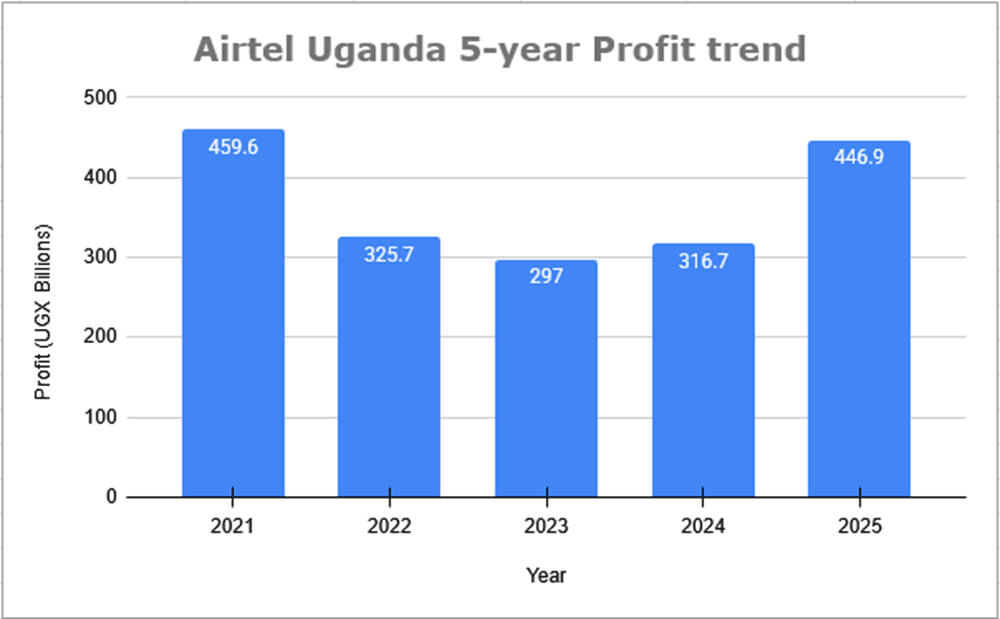
- 2021: ~UGX 460 billion (a high point at the time)
- 2022: ~UGX 326 billion (noticeable drop, likely from post-pandemic adjustments and costs)
- 2023: ~UGX 297 billion (further softening, around a 9% decline from 2022)
- 2024: UGX 317 billion (modest recovery, up about 7% from 2023)
- 2025: UGX 447 billion (sharp rebound, +41% from 2024 and the new record high)
This shows a pattern of earlier declines (possibly tied to regulatory changes, economic factors, or competition), followed by stabilization in 2024 and then explosive growth in 2025—fueled by the data boom overtaking voice and strong cost controls. It’s a clear sign of the company’s successful pivot to Uganda’s fast-growing digital economy!
Airtel isn’t just about selling phone credit anymore. It’s growing into a bigger tech player, especially for businesses and government projects. Through its “Network as a Service” model, Airtel provides full connectivity solutions—like high-speed internet, secure networks, and firewalls—so companies don’t have to handle the tech side themselves. A good example is the Hoima City Stadium project, where Airtel handles all the ICT and connection needs. This move into business services (B2B) helps protect the company from ups and downs in regular phone call sales.
For investors (Airtel is listed on the Uganda Securities Exchange), the good news keeps coming. The board recommended a final dividend of UGX 3.55 per share, making the total dividend for 2025 UGX 11.15 per share—that’s a 41.6% increase from last year. Shareholders are getting a nice reward!
Uganda has great 4G coverage now—Airtel’s network claims to reach 98.9% of the population, and the country as a whole has 96% 4G coverage. But there’s still work to do: Many people have access but don’t use it much (the “usage gap” is about 75%, according to the GSMA telecom association).
Airtel’s next big goal for 2026 is to close that gap. CEO Sahu called it a “transformative year” with more investments to make the internet faster, safer, easier, and more useful for everyone in Uganda.


