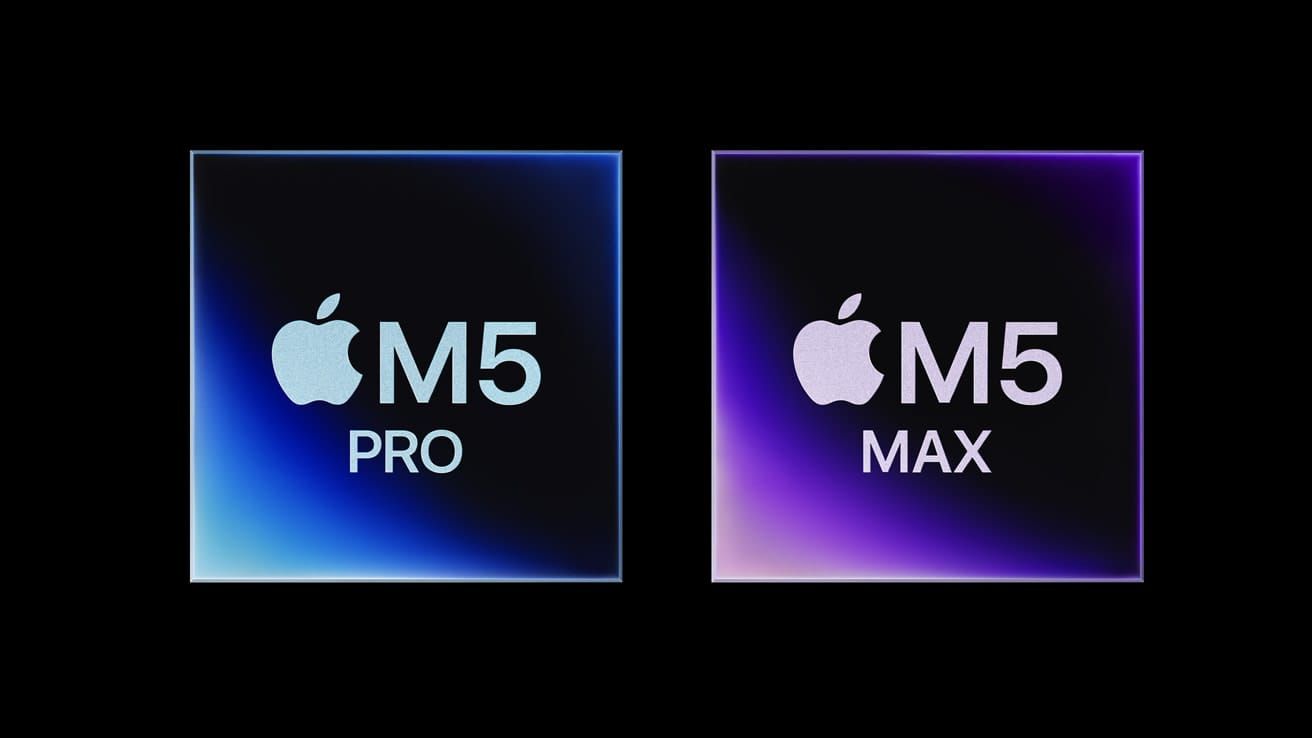


The Apple M5 Pro and M5 Max represent Apple’s latest high-performance chips in the M5 series, specifically designed to power the refreshed 14-inch and 16-inch MacBook Pro models.
Announced on March 3, 2026, these chips deliver breakthrough advancements in professional-grade performance, with a strong emphasis on on-device artificial intelligence, graphics-intensive tasks, and sustained multithreaded workloads, all while preserving exceptional battery efficiency.
At the core of both the M5 Pro and M5 Max is Apple’s innovative Fusion Architecture. This design cleverly combines two dies into a single, unified system-on-a-chip (SoC), integrating a powerful CPU, a scalable GPU, a media engine, a unified memory controller, the Neural Engine, and even Thunderbolt 5 support. This architecture enables significant leaps in overall performance and efficiency compared to prior generations.

A standout feature is the inclusion of a dedicated Neural Accelerator built directly into each GPU core. This per-core AI hardware acceleration dramatically boosts on-device machine learning and AI capabilities, allowing professionals to run advanced large language models (LLMs), perform complex AI-driven workflows, and handle generative tasks locally without relying on cloud resources.
Apple claims this results in up to 4 times the AI performance versus the previous M4 Pro and M4 Max generation, and as much as 8 times the AI performance compared to the original M1-series chips.
The CPU in both chips reaches up to an 18-core configuration, featuring 6 high-performance “super cores” — which Apple describes as the world’s fastest single CPU cores for exceptional single-threaded responsiveness — paired with 12 all-new performance cores.
These performance cores are specially optimized for power-efficient, sustained multithreaded professional tasks such as coding, data processing, simulations, and rendering.
The secret sauce
Apple continues its unified memory approach, but with major upgrades:
| Feature | M5 Pro | M5 Max |
| Maximum Unified Memory | Up to 64GB | Up to 128GB |
| Memory Bandwidth | Up to 307 GB/s | Up to 614 GB/s (double the Pro) |
| GPU Cores | Up to 20 | Up to 40 (base 32 in entry models) |
| CPU Configuration | Up to 18 cores (15-core base) | Full 18 cores (6 super + 12 perf) |
The doubled bandwidth on the M5 Max is especially critical for memory-hungry tasks: 8K video editing, complex 3D simulations, training or running huge AI models locally, and scientific computing.
Together, this CPU setup delivers up to 30 percent faster multithreaded performance in demanding pro workloads compared to the prior generation. In some base configurations of the M5 Pro, the CPU steps down to 15 cores (5 super cores + 10 performance cores), but the M5 Max consistently offers the full 18-core setup.
The GPU is where the most dramatic differentiation occurs between the two variants. The M5 Pro scales up to 20 GPU cores (with base models often starting at 16 cores), while the M5 Max pushes further to up to 40 GPU cores (typically starting at 32 cores in entry-level configurations).
Both benefit from a next-generation GPU architecture that includes third-generation ray tracing, hardware-accelerated mesh shading, and improved dynamic caching for better resource utilization. These enhancements provide up to 35 percent faster ray tracing in supported applications, making them ideal for 3D rendering, video effects, and real-time graphics.
The built-in Neural Accelerators further amplify GPU compute for AI-specific tasks, enabling massive gains in areas like image generation, video upscaling, and on-device model inference.
Unified memory remains a key strength of Apple’s silicon, with the M5 Pro supporting configurations up to 64GB and memory bandwidth reaching up to 307 GB/s. In contrast, the M5 Max doubles down with support for up to 128GB of unified memory and bandwidth soaring to up to 614 GB/s — essentially twice that of the Pro variant.
This higher capacity and bandwidth are crucial for memory-intensive professional workflows, such as editing 8K video, working with enormous datasets, running large-scale simulations, or loading massive AI models entirely into memory for faster processing.
These chips also come paired with other system-level upgrades in the new MacBook Pro lineup. Storage performance sees up to 2 times faster read/write speeds in certain configurations, with base storage bumped to 1TB for M5 Pro models and 2TB for M5 Max models.
Connectivity includes the new Apple-designed N1 wireless chip for Wi-Fi 7 and Bluetooth 6, delivering faster and more reliable wireless performance. The laptops maintain up to 24 hours of battery life for video playback, feature the stunning Liquid Retina XDR display (with optional nano-texture glass), Thunderbolt 5 ports, a 12MP Center Stage camera, studio-quality microphones, a six-speaker sound system with Spatial Audio, and full integration with Apple Intelligence features running on macOS Tahoe.
Target workloads
Apple’s official benchmarks (shared during today’s event) highlight:
- M5 Pro: Up to 30% faster multithreaded CPU performance vs. M4 Pro; >4× peak GPU compute for AI tasks
- M5 Max: Up to 15% higher multithreaded performance vs. M4 Max; massive gains in GPU-intensive workloads thanks to the core doubling
Ideal for M5 Pro:
- Software developers
- Photographers & light video editors
- Data scientists running complex algorithms
- 4K video workflows
- General pro users who want maximum efficiency
Ideal for M5 Max:
- Hollywood-level video editors (8K RAW)
- 3D artists and animators
- AI researchers training or inferencing large models locally
- Engineers running simulations or CAD
- Anyone who routinely maxes out GPU and memory resources
In terms of target users, the M5 Pro strikes an excellent balance for most professionals, offering substantial improvements in CPU multithreading (up to 30 percent faster), more than 4 times the peak GPU compute for AI tasks, and strong overall efficiency — making it well-suited for software development, photo and video editing, data science, and complex algorithmic work.
The M5 Max, however, is positioned for the most extreme demands, where the doubled GPU cores, vastly higher memory bandwidth, and 128GB ceiling unlock unparalleled performance in GPU-heavy or memory-bound scenarios like Hollywood-grade 8K video production, advanced 3D animation, scientific computing, or local training/inference of very large AI models.
Pre-orders for the new MacBook Pro models began on March 4, 2026, with availability starting March 11, 2026, in finishes like space black and silver.


