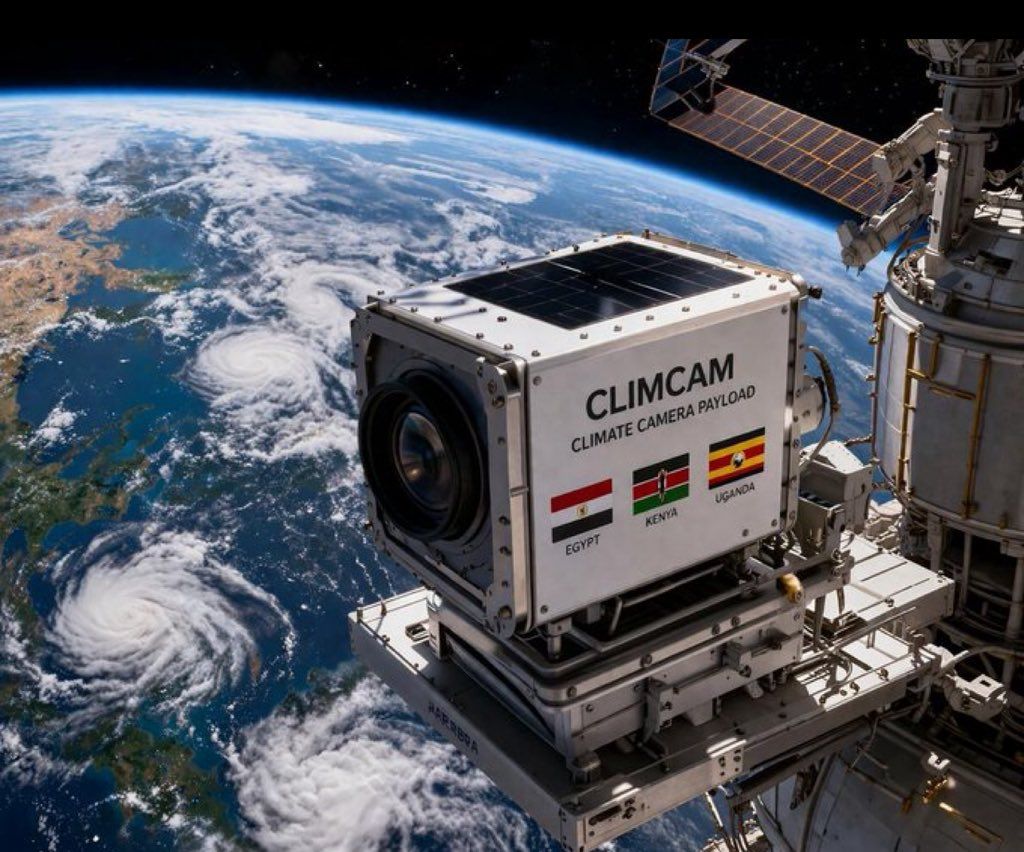


As Uganda prepares for National Science Week 2026, another headline from the Science, Technology and Innovation (STI) ecosystem is making waves; not on the roads like the Kayoola electric bus, but far above them. On April 10th, 2026, a Ugandan-involved payload called ClimCam, an AI-powered climate monitoring camera, is scheduled to launch aboard a SpaceX Falcon 9 rocket toward the International Space Station (ISS).
Once installed on the Airbus Bartolomeo platform, it will provide high-resolution Earth observation data focused on East Africa.
ClimCam is a joint Earth-observation mission developed by the Uganda National Space Programme (under the Ministry of Science, Technology and Innovation), the Kenya Space Agency, and the Egyptian Space Agency. The three countries collaborated on the design and development, with Uganda sponsoring the training of four engineers who contributed to building components at the Egyptian Space Agency facilities in Cairo.

The project was selected under the United Nations Office for Outer Space Affairs (UNOOSA) and Airbus “Access to Space for All” programme; one of the few ways smaller nations can get hardware to the ISS without launching their own satellite from scratch.
The camera is equipped with machine learning capabilities, designed to capture images and generate near-real-time insights on environmental and climate conditions. According to officials, it will monitor the region at least four times a day once operational (expected around August 2026).
Potential applications include:
- Early warning for floods and droughts
- Support for agriculture and food security
- Disaster response and natural resource management
- Tracking ecosystem changes linked to climate change
For a country like Uganda, where climate variability regularly disrupts farming, triggers landslides, and affects Lake Victoria basin communities, space-based data could theoretically strengthen forecasting where ground-based weather stations remain sparse or under-resourced.
This marks Uganda’s second foray into space-related activity (following earlier small satellite efforts). Government statements frame ClimCam as proof that deliberate investment in STI is yielding concrete results, part of the same narrative driving National Science Week, which highlights “what is already working” in mobility, digital innovation, and now space tech.
Yet, as with many ambitious African space and tech initiatives, the gap between orbital hardware and tangible local impact often hinges on downstream capabilities. Having a camera in orbit is one thing; turning its raw imagery and AI-processed outputs into timely, actionable alerts for farmers, district disaster committees, or policymakers is another.
It will require robust ground infrastructure, data processing capacity, trained analysts, and integration with existing meteorological systems, areas where East Africa has made progress but still faces challenges in consistency and coverage.
The regional collaboration aspect is noteworthy. Unlike purely national projects, ClimCam represents one of the first consolidated space efforts between Uganda, Kenya, and Egypt specifically targeting shared climate threats. In a continent where cross-border data sharing on weather and disasters can be uneven, this trilateral approach could set a modest precedent, provided the data generated is openly accessible and used collaboratively.
Dr Monica Musenero, Minister of Science, Technology and Innovation, has linked the project to Uganda’s broader push toward a USD 500 billion economy, arguing that science-driven solutions in climate resilience are as critical as electric buses or game development. During events leading into National Science Week, she highlighted ClimCam as evidence of Uganda moving from “pathfinding” to “acceleration.”
Sceptics might point out that launches and payloads often generate more media attention than sustained operational value, especially when funding for maintenance, data analysis, and local application can lag. Uganda’s space programme is still young, and success will ultimately be measured not by reaching the ISS, but by whether ClimCam’s data helps reduce flood-related losses, improves crop yields, or informs better environmental policy in the coming years.
Still, the symbolism is hard to ignore. A compact, AI-enhanced camera built with Ugandan engineering input riding on a Falcon 9 to the ISS shows that East African nations are no longer content to be passive consumers of satellite data from Europe, America, or China. They are attempting to participate in generating their own.


